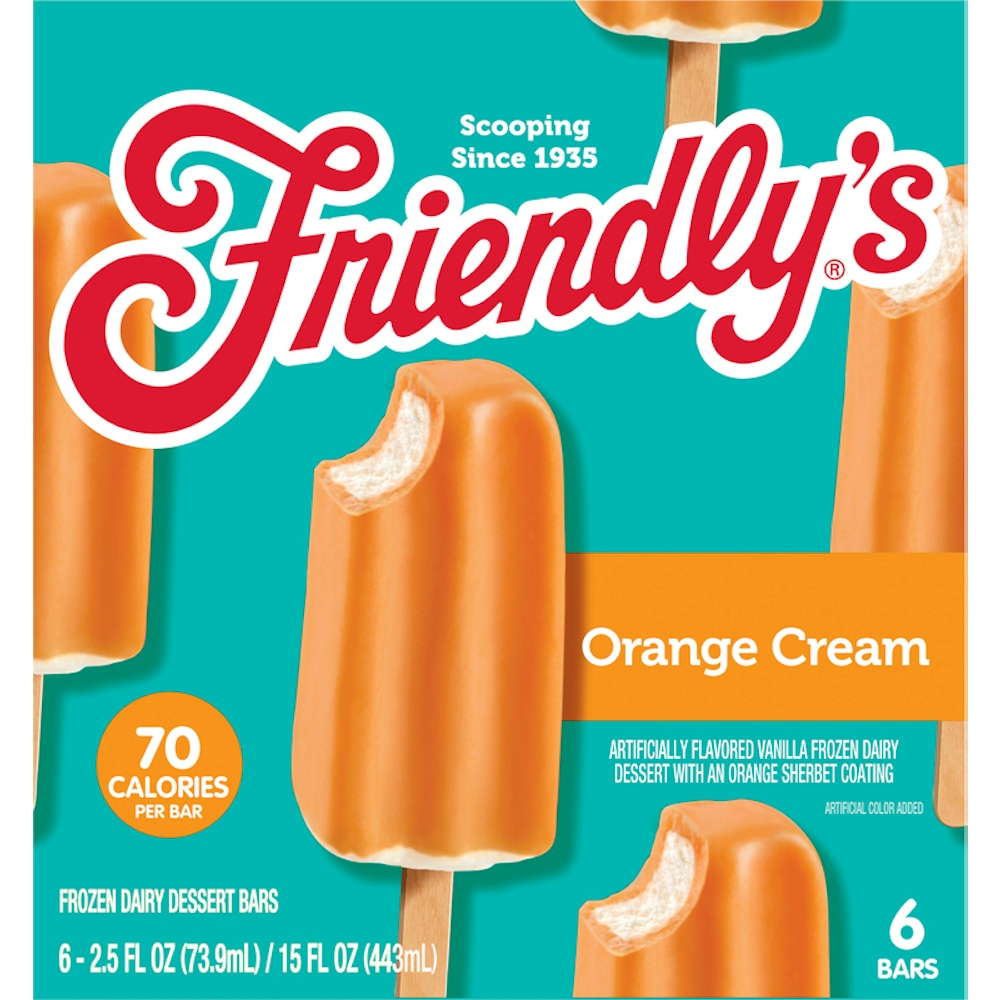
Are Friendly's Orange Cream Bars Clean? Every Ingredient, Scanned
Friendly's Orange Cream bars stack two sweeteners, four gums, carrageenan and two certified dyes (Red 40, Yellow 6). What each does, and where the dye phase-out stands.
Written by Chris Carrillo. Reviewed by Armin Rad, Co-Founder & CTO, Aurascan. It cites 6 sources; use the source list and methodology to check the evidence directly.
Friendly's Orange Cream ice cream bars combine a classic vanilla ice cream core inside a tangy orange sherbet shell. While they deliver familiar nostalgic flavor, an ingredient scan reveals synthetic certified dyes like Yellow 6 and Red 40, a complex blend of stabilizers, and multiple corn syrups. Here is an evidence-based breakdown of what every component on the packaging actually does.
Key takeaways:
Friendly's Orange Cream bars use a dual-layer structure combining an ice cream core and an orange sherbet shell, stabilized by vegetable gums, carrageenan, and emulsifiers.
The product contains petroleum-derived dyes (Yellow 6 and Red 40) that are FDA-approved for general use but face state-level public school bans under California's AB 2316 effective late 2027.
The sweetening system relies on sugar, corn syrup, and high fructose corn syrup to prevent ice crystallization and keep the bar scoopable at freezing temperatures.
Aurascan provides ingredient-by-ingredient safety and regulatory analysis with cited evidence without assigning a single arbitrary numeric score.
Why people buy it
For many shoppers, the appeal of Friendly's Orange Cream bars lies in pure summer nostalgia. The marriage of creamy vanilla dairy paired with a tart, citrusy outer shell replicates the iconic creamsicle profile that has been a staple of ice cream trucks and family freezers for decades. Consumers reach for them as a portion-controlled dessert that feels lighter than a heavy pint of super-premium ice cream.
Convenience also drives purchases. Multi-packs make it easy to hand out treats to children or enjoy a quick dessert without scooping. However, shoppers reading the back panel often find themselves puzzled by the long list of unfamiliar texturizers, multiple forms of concentrated sugars, and certified artificial food colors.
Analysis by Aurascan. Sources are listed on the product page.
What Aurascan found
When we evaluate the complete ingredient list, the formulation splits into four functional categories: the dairy foundation, the sweetener system, the stabilizer-emulsifier matrix, and the coloring agents.
Synthetic Colorants: Yellow 6 and Red 40
The vibrant orange hue of the outer shell is created using a combination of natural annatto extract alongside synthetic dyes Yellow 6 (Sunset Yellow FCF) and Red 40 (Allura Red). Yellow 6 is regulated under 21 CFR 74.706, which mandates strict batch certification by regulators to ensure purity limits on heavy metals and unreacted intermediates.
While certified food colorings remain legally approved for general commercial food distribution across the United States, they have faced heightened scrutiny. As of mid-September 2026, two developments matter. California's Assembly Bill 2316 (the School Food Safety Act) bars Yellow 6, Red 40 and four other synthetic dyes from public school meals from the end of 2027, citing concerns about hyperactivity in sensitive children. And the FDA's 2025 push to phase out petroleum-based dyes now runs through a public list of company pledges; our FDA dye tracker update covers where the big brands stand. The same dyes appear in Doritos Nacho Cheese; for a dye-free contrast, Sprite is colorless by design.
Emulsifiers and Stabilizers: Carrageenan, Mono- and Diglycerides, and Gums
Maintaining a smooth frozen dairy texture through commercial shipping requires a sturdy hydrocolloid matrix. Friendly's utilizes a multi-gum blend including guar gum (regulated under 21 CFR 184.1339), locust bean gum (21 CFR 184.1343), and cellulose gum, complemented by carrageenan and mono- and diglycerides.
These functional ingredients serve explicit physical roles:
Guar Gum & Locust Bean Gum: Plant-derived polysaccharides that bind free water, preventing ice crystal formation during temperature fluctuations (heat shock) in standard grocery freezers.
Mono- and Diglycerides: Surface-active lipids that hold the water and dairy fat phases together, ensuring a smooth, uniform mouthfeel.
Carrageenan: A red seaweed extract that stabilizes milk proteins against phase separation.
Between 2024 and 2026, dietary research has increasingly examined the interaction between synthetic emulsifiers and the human gut microbiome. Preliminary studies suggest that heavy daily exposure to certain food emulsifiers such as carrageenan may alter the mucosal layer and gut microbiota composition in animal models. Regulatory bodies such as the FDA and the European Food Safety Authority (EFSA) currently consider these additives safe within established food tolerances.
Sweetener System: Corn Syrup and High Fructose Corn Syrup
The sweetening profile combines regular table sugar (sucrose), corn syrup, and high fructose corn syrup (HFCS). In frozen desserts, sugars do far more than add sweetness. They depress the freezing point of water.
By blending sucrose with corn syrup and HFCS, manufacturers control how hard the product freezes. This dual sweetener approach prevents the sherbet shell from freezing into solid ice and ensures the inner cream core bites cleanly rather than crumbling. To check the exact sugar quantities and daily values, consult the Nutrition Facts panel on the box.
What is the difference between sherbet and ice cream?
The Food and Drug Administration maintains distinct legal standards of identity for frozen desserts. Understanding these rules clarifies why Friendly's lists both skim milk and whey alongside citrus components.
Under federal standards, standard ice cream must contain a minimum of 10% milkfat. Sherbet, in contrast, must contain between 1% and 2% milkfat, paired with characteristically acidic fruit flavorings and a minimum of 0.35% total titratable acidity. This is why citric acid is included in the shell: it provides the essential tartness required to balance the sugars and meet the flavor profile expected of orange sherbet.
When shopping for frozen novelties, reviewing the ingredient deck helps you make informed choices tailored to your household's dietary priorities.
Check for certified dyes: Look for Yellow 5, Yellow 6, or Red 40 if you are actively avoiding synthetic colors for young children.
Identify the fat source: Verify whether the bar is classified as an ice cream, a sherbet, or a frozen dairy dessert, which indicates the level of dairy fat present.
Scan the gum blend: Consumers with sensitive digestion often prefer frozen treats made with simple cream and sugar over formulations containing extensive gum matrices.
Inspect the sweetener hierarchy: Note whether sugar, HFCS, or non-nutritive sweeteners head the ingredient list.
It is important to note that nutritional science cannot establish uniform individual responses for every consumer. How an individual reacts to dietary emulsifiers, corn syrups, or synthetic dyes depends heavily on personal gut sensitivity, overall dietary variety, and genetic factors.
Scan the box in your freezer with the Aurascan app to see each of these ingredients explained one by one, then scan a five-ingredient pint next to it for the contrast.
Do Friendly's Orange Cream bars contain real fruit juice?
Friendly's Orange Cream bars rely primarily on natural and artificial flavors, citric acid, and colorants to achieve their citrus profile rather than substantial amounts of concentrated orange fruit juice.
Are the dyes in Friendly's Orange Cream bars banned in the US?
No. Yellow 6 and Red 40 are approved by the FDA for general commercial food use. However, California's AB 2316 restricts these dyes in public school meals starting in late 2027.
Why does Friendly's use both ice cream and sherbet in this bar?
The dual-layer structure uses traditional orange sherbet for the tangy outer coating and a dairy ice cream core for a rich, smooth center, meeting separate FDA standards of identity for each layer.
What is the purpose of carrageenan and guar gum in frozen bars?
Guar gum, carrageenan, and other stabilizers bind free water molecules to prevent ice crystals from forming during temperature changes, keeping the dessert smooth.
Is high fructose corn syrup safe in frozen dairy desserts?
High fructose corn syrup is recognized as safe by the FDA and acts as a freezing-point depressant to keep frozen novelties soft enough to bite.
See what is in your label
Aurascan turns product labels into plain-English ingredient explanations and source-backed context.
Carbonated water, caramel color, aspartame, phosphoric acid, potassium benzoate, natural flavors, citric acid: what each does, what regulators say, and the scan.
Dole 100% Pineapple Juice adds no sugar, yet a glass carries soda-level sugar. What "100% juice" and "from concentrate" mean under FDA rules, and why vitamins are added.