
Product Education · October 12, 2026 · Updated October 28, 2026 · 8 min read
Does Fresca Have Aspartame? Yes, Plus Ace-K: Label Read
Yes: Fresca Grapefruit Citrus lists aspartame (5th ingredient) and acesulfame potassium (8th), no sugar. Every ingredient, plus caffeine and sodium.
By Chris Carrillo · Reviewed by Armin Rad, Co-Founder & CTO, Aurascan · October 28, 2026
Every article is checked against primary sources before publication. How we review

Yes. Fresca Grapefruit Citrus contains aspartame, listed as the 5th ingredient, and acesulfame potassium, listed as the 8th, and its ingredient list shows no sugar. Both are high-intensity sweeteners, and the can carries the phenylketonuria warning that federal rules require for aspartame. The FDA permits both additives and disagrees with the 2023 IARC Group 2B classification of aspartame.
Key takeaways
- Aspartame is the 5th ingredient and acesulfame potassium the 8th. No sugar, sucralose, or stevia is listed on the Coca-Cola brand page or the Open Food Facts listing, which match word for word.
- Concentrated grapefruit juice is the 3rd ingredient, but the Open Food Facts can photo is headed 'LESS THAN 1% JUICE', so the grapefruit share of the drink is small.
- The FDA's aspartame ADI is 50 mg/kg body weight per day. JECFA's is 40 mg/kg. IARC classed aspartame as Group 2B in 2023.
- EFSA's 2025 re-evaluation of acesulfame K set its EU ADI at 15 mg/kg body weight per day, replacing the earlier 9 mg/kg.
- The can says caffeine free, and no caffeine source appears in the ingredient list.
Why people buy Fresca Grapefruit Citrus (and what the label answers first)
Fresca is a sugar-free grapefruit sparkling soda made by Coca-Cola. Coca-Cola's brand page calls the Grapefruit Citrus flavor 'The original no sugar, no calorie sparkling beverage' and lists it in 12 fl oz, 16.9 fl oz, 20 fl oz, and 2 Liter sizes. Shoppers who search for the brand often ask the same questions: whether it has caffeine, sugar, calories, aspartame, or real grapefruit, and whether it counts toward water intake.
The label answers the sweetener and sugar questions first, because those drive most of the searches. This guide follows those questions, starts with the printed ingredient list, and then explains what regulators say about each additive. Readers comparing it with another diet soda can read our Fresca vs. Diet Coke comparison.
Scan preview
Fresca
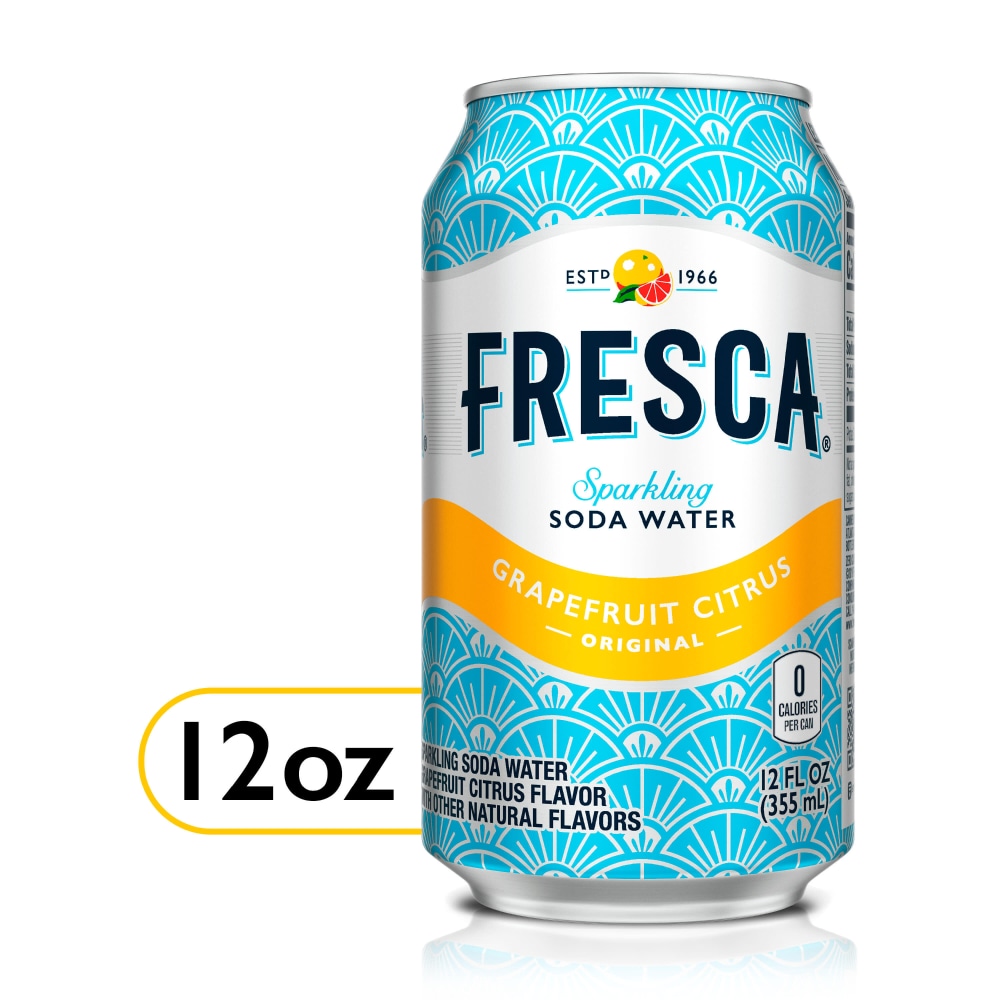
Fresca Grapefruit Citrus Sparkling Soda Water
Citric Acid · Concentrated Grapefruit Juice · Potassium Citrate
Analysis by Aurascan. The app shows the full breakdown and its sources.
Does Fresca have aspartame, acesulfame K, or sugar? The direct label answer
Yes. Fresca Grapefruit Citrus lists aspartame as its 5th ingredient and acesulfame potassium as its 8th. The ingredient list shows no sugar, and neither sucralose nor stevia appears. The Coca-Cola brand page and the Open Food Facts listing match word for word and in the same order, with 13 ingredients: carbonated water, citric acid, concentrated grapefruit juice, potassium citrate, aspartame, potassium sorbate, acacia gum, acesulfame potassium, natural flavors, glycerol ester of rosin, potassium benzoate, calcium disodium EDTA, and carob bean gum.
Per 12 fl oz (355 mL) can, the brand page lists 0 calories, 0g total fat, 35mg sodium (2% Daily Value), 1g total carbohydrates (0% Daily Value), 0g protein, and 80mg potassium (2%). Open Food Facts records 0 kcal, 0 g sugars, and 35 mg sodium for the same serving. The printed 1g of carbohydrate is rounded, and the exact sub-gram value was not disclosed.
The milligrams of aspartame and acesulfame potassium per can were not disclosed by Coca-Cola, so no per-can sweetener figure can be given. Also note that Fresca Prebiotic, another product on the same brand page, lists aspartame and acesulfame potassium too. No Fresca shown on that page is aspartame-free.
Is aspartame safe? What the FDA and JECFA say, and the IARC 2B dispute
The FDA regulates aspartame as a food additive. It was first regulated in 1974 and approved as a general-purpose sweetener in 1996. The agency describes it as about 200 times sweeter than table sugar and sets an acceptable daily intake (ADI) of 50 mg per kg of body weight per day. For a 60 kg (132 lb) person, reaching that ADI would take 75 tabletop packets per day.
The Joint FAO/WHO Expert Committee on Food Additives (JECFA) reaffirmed an acceptable daily intake of 40 mg/kg body weight. The two bodies use different numbers and methods, so the figures should not be mixed. In July 2023, the International Agency for Research on Cancer (IARC) classified aspartame as 'possibly carcinogenic to humans' (Group 2B), citing limited evidence. The FDA said that classification 'does not mean that aspartame is actually linked to cancer,' disagreed with IARC's conclusion, and noted that JECFA 'did not change the Acceptable Daily Intake (ADI).'
WHO offered a generic example: an adult weighing 70 kg would need to drink more than 9 to 14 cans of a diet soft drink containing 200 or 300 mg of aspartame per day to exceed the ADI. That example is not a measurement of Fresca. Coca-Cola does not publish the aspartame content of this can, so the example cannot be applied to it.
Is acesulfame potassium safe? FDA status and EFSA's 2025 re-evaluation
The FDA regulates acesulfame potassium as a food additive. It was approved in 1988 for specific food categories and in 2003 as a general-purpose sweetener. The agency describes it as about 200 times sweeter than table sugar and often combined with other sweeteners. The FDA's ADI is 15 mg/kg body weight per day, and the agency says it reviewed more than 90 studies. U.S. permitted uses are set out in 21 CFR 172.800.
The European Food Safety Authority (EFSA) published a re-evaluation of acesulfame K (E 950) in April 2025. Its panel set an ADI of 15 mg/kg body weight per day, replacing the 9 mg/kg figure set earlier by the EU Scientific Committee on Food, and noted that the highest exposure estimates were generally below that ADI.
In the United States, the FDA's own ADI for acesulfame potassium is the same 15 mg/kg figure.
Quiz
Zero sugar and zero calories, but aspartame plus acesulfame K. How do you think a full scan rates this Fresca can?
Guess before you scroll.
Reveal Aurascan's verdict
Aurascan says: Flagged
The main flag is Citric Acid.
Does Fresca have caffeine?
The can says caffeine free. The Open Food Facts photo of the nutrition panel prints 'ZERO CALORIE/CAFFEINE FREE', and no caffeine source appears in either ingredient list. Caffeine content in milligrams is not published, so no caffeine number can be given.
The brand page does not use the word caffeine in its Grapefruit Citrus description. It does describe the Black Cherry Citrus flavor as 'zero sugar, zero caffeine' and Fresca Prebiotic as 'an everyday caffeine-free soda.'
How much real grapefruit is in Fresca? Juice share on the label
Concentrated grapefruit juice is the 3rd ingredient, so it appears ahead of the sweeteners and preservatives. The Open Food Facts can photo is headed 'LESS THAN 1% JUICE', which points to a small juice share. An exact percentage beyond that was not disclosed. Citric acid and potassium citrate are also listed, and the natural flavors are not described in the sources, so their contents are unknown.
Several ingredients are included to protect taste or stability. Potassium sorbate is listed 'to protect taste,' and 21 CFR 182.3640 describes it as generally recognized as safe when used in accordance with good manufacturing practice. Calcium disodium EDTA is permitted in canned carbonated soft drinks at up to 33 parts per million under 21 CFR 172.120 to promote flavor retention. Glycerol ester of rosin may be used to adjust the density of citrus oils, at no more than 100 parts per million of the finished beverage, under 21 CFR 172.735.
Potassium benzoate needs careful reading. No specific U.S. regulation for the potassium salt is cited here. Sodium benzoate is a different salt covered at 21 CFR 184.1733, and it should not be assumed to apply. FDA explains that benzene can form at very low levels in some beverages that contain both benzoate salts and ascorbic acid or erythorbic acid. Fresca's list names neither vitamin C form, and FDA has published no Fresca-specific benzene result. FDA also states that benzene levels found in beverages to date do not pose a safety concern for consumers.
Who should be cautious with Fresca: phenylketonuria, sweetener sensitivity, caffeine
The most specific warning on this can is for people with phenylketonuria (PKU). The label reads 'PHENYLKETONURICS: CONTAINS PHENYLALANINE,' the wording that 21 CFR 172.804 requires on products containing aspartame. The FDA states that people with PKU should avoid or restrict aspartame.
Sweetener sensitivity is harder to define. Regulators set ADIs for the general population, and the available sources do not establish how any one person responds to aspartame or acesulfame potassium. Anyone who notices symptoms after drinks with these sweeteners can raise them with a clinician, who can interpret them in context.
People who limit caffeine can note the can's caffeine free statement. Caffeine in milligrams was not disclosed.
The evidence has clear limits. ADIs rest on population-level data, the aspartame and cancer question remains disputed among regulators, and no source reviewed here studies how this specific product affects any group. These open questions mean the label facts above are a starting point, not a final answer about any individual's health.
What to look for on the label when comparing Fresca with other sparkling sodas
Use this checklist when comparing Fresca with another sparkling soda:
- Sweetener names and their position in the ingredient list. In this can, aspartame is 5th and acesulfame potassium is 8th.
- The phenylketonurics statement, which appears when aspartame is present.
- The caffeine statement.
- Where fruit juice falls in the ingredient list, and any juice percentage printed on the panel.
- Calories and serving size. This can lists 0 calories per 12 fl oz.
- Sodium. This can lists 35 mg per serving, which is 2% of the 2,300 mg FDA Daily Value.
- Preservatives and processing aids, such as potassium sorbate and calcium disodium EDTA, along with the stated purpose on the label.
For a side-by-side read, see Sprite vs. Fresca. Readers looking at other citrus sodas can check Is Fanta Orange Clean? Every Ingredient, Scanned and Is Fanta Pineapple Clean? Every Ingredient, Scanned.
Try Aurascan
See what is really in the food you buy.
Common questions
- Does Fresca Grapefruit Citrus have aspartame?
- Yes. Aspartame is the 5th ingredient in Fresca Grapefruit Citrus, and acesulfame potassium is the 8th. Both are listed on the Coca-Cola brand page and the Open Food Facts listing, which match word for word.
- Does Fresca have caffeine?
- The can says caffeine free, and no caffeine source appears in either ingredient list. Caffeine in milligrams was not disclosed.
- Does Fresca have sugar or calories?
- The brand page lists 0 calories and no sugar for a 12 fl oz (355 mL) can, and sugar does not appear in the ingredient list. The printed total carbohydrate is 1g, which is rounded.
- Does Fresca have real grapefruit juice in it?
- Yes, concentrated grapefruit juice is the 3rd ingredient. The Open Food Facts can photo is headed 'LESS THAN 1% JUICE', so the juice share is small. An exact percentage was not disclosed.
- Is aspartame safe according to the FDA?
- The FDA regulates aspartame as a food additive and sets an acceptable daily intake of 50 mg/kg body weight per day. IARC classified it as Group 2B in 2023, and the FDA disagrees with that conclusion, while JECFA kept its ADI unchanged.
- Is Fresca a Coca-Cola product?
- The Open Food Facts can photo reads 'CANNED UNDER AUTHORITY OF THE COCA-COLA COMPANY, ATLANTA, GA', and the brand page is hosted on coca-cola.com.
- Is Fresca safe for people with phenylketonuria?
- The label carries the warning 'PHENYLKETONURICS: CONTAINS PHENYLALANINE', and the FDA states that people with PKU should avoid or restrict aspartame. Anyone with PKU should follow advice from their own clinician.
Sources
- Fresca Sparkling Soda Brand Page, Coca-Cola (coca-cola.com)
- Open Food Facts product 049000002485 (API) (world.openfoodfacts.org)
- Aspartame and Other Sweeteners in Food (fda.gov)
- 21 CFR 172.804 Aspartame (ecfr.gov)
- WHO: Aspartame hazard and risk assessment results (14 July 2023) (who.int)
- Questions and Answers on Benzene in Soft Drinks and Other Beverages (fda.gov)
- Re-evaluation of acesulfame K (E 950) as food additive (ncbi.nlm.nih.gov)
- Daily Value on the Nutrition and Supplement Facts Labels (fda.gov)
In this series
Guide
Are Stacy's Pita Chips Clean? Every Ingredient, ScannedGuide
Is Frigo String Cheese Clean? Four Ingredients, ScannedGuide
Is the Nature's Bakery Fig Bar Clean? Every Ingredient, ScannedGuide
Is Tillamook Cookie Dough Ice Cream Clean? 25 Ingredients, ScannedGuide
Is SkinnyPop Clean? Three Ingredients, ScannedGuide
Is Häagen-Dazs Chocolate Clean? Five Ingredients, Scanned
Related guides
Comparisons
Is Outshine Healthier Than Popsicle? 12g Sugar vs AspartameOutshine Strawberry lists 12 g added sugar per bar and no low-calorie sweeteners; Popsicle Orange Cherry Grape uses aspartame and ace-K, 0 g sugar.
Comparisons
Which Has More Sugar, Jell-O or Snack Pack? 17 g vs 12 gJell-O lists 17 g added sugar and artificial color per 110 g cup; Snack Pack Chocolate lists 12 g per 92 g cup and no added color.
Comparisons
Does Prego Have Added Sugar? Yes, 4 g vs Ragú's <1 gPrego Traditional lists 4 g added sugar per 1/2 cup; Ragú Old World Style Traditional lists under 1 g. Sodium, oil and ingredient order compared.
Try it on your own groceries
Scan your next label with Aurascan
Point the camera at any ingredient list and get the same evidence-graded read you see here.
Open the scannerGet food recall alerts + a weekly digest
An email when a food recall is announced, plus one weekly roundup of label news and new guides.
We email a confirmation link first - nothing is sent until you click it. Unsubscribe anytime. Privacy