
Product Education · September 20, 2026 · 8 min read
Are Stacy's Pita Chips Clean? Every Ingredient, Scanned
Enriched wheat flour, sunflower and/or canola oil, two Parmesans and a 2-percent tail with rosemary extract. Stacy's Parmesan Garlic and Herb pita chips, line by line.
By Chris Carrillo · Reviewed by Armin Rad, Co-Founder & CTO, Aurascan · September 20, 2026
Every article is checked against primary sources before publication. How we review
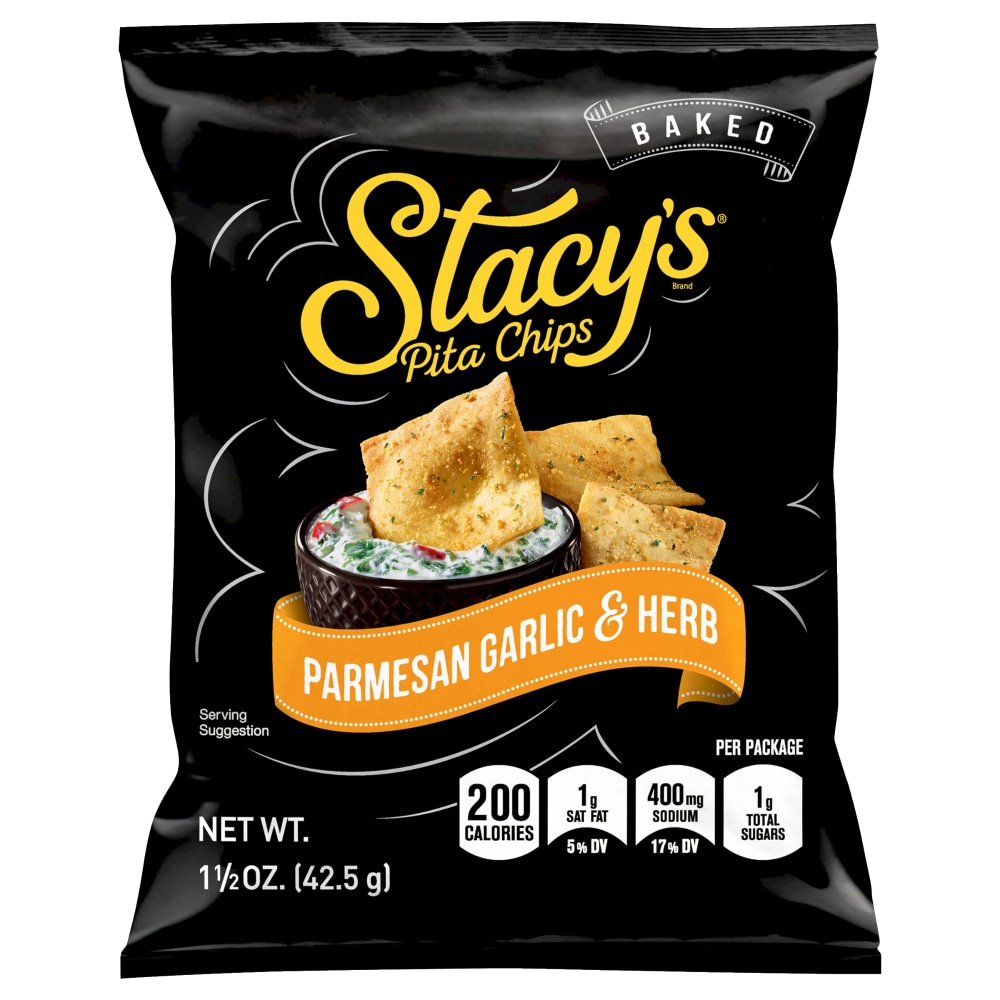
Stacy's Parmesan Garlic and Herb Pita Chips combine enriched refined wheat flour, vegetable oils, and two distinct Parmesan cheese formulations with natural botanical antioxidants. While marketed as a rustic oven-baked snack, its deck features flexible seed oil sourcing, yeast fermentation aids, and dual-phase dairy seasoning. Every additive serves a specific shelf-life or textural function.
Key takeaways:
- Parmesan cheese is declared twice because the recipe incorporates both a whole-milk Parmesan in the primary dough and a part-skim Parmesan seasoning in the sub-2-percent tail.
- The manufacturer lists sunflower oil and/or canola oil under federal flexibility rules, allowing them to alternate frying or baking fats based on commodity markets without redesigning the packaging.
- Malted barley flour adds barley gluten beyond the declared wheat flour, meaning the product contains multiple sources of gluten even though only wheat is required as an allergen callout.
- Rosemary extract and ascorbic acid are functional antioxidants added specifically to protect unsaturated fats from turning rancid, rather than to contribute herbal seasoning.
- As of September 2026, no ingredient in these chips is subject to a ban or new restriction.
Why people buy it
Shoppers frequently turn to Stacy's Parmesan Garlic and Herb Pita Chips when looking for a savory, hearty alternative to conventional potato chips. The prominent "baked" claim on the package appeals to consumers who want a crisp texture that feels sturdier for thick dips like hummus or spinach artichoke dip. Because pita chips are derived from real baked bread dough, many buyers perceive them as a more wholesome, pantry-staple snack compared to puffed or extruded snacks.
Flavor profile is another strong driver. The blend of aged cheese, dried garlic, and aromatic herbs creates a gourmet impression that fits well on charcuterie boards and party platters. However, reading past the rustic package aesthetic into the actual ingredient list reveals complex industrial baking methods, flexible oil sourcing, and dual-phase dairy additions that consumers often overlook.
Scan preview
Stacy's
Stacy's Baked, Parmesan Garlic & Herb, Pita Chips
_wheat_ Flour · Folic Acid · Sunflower Oil And/or Canola Oil
Standout ingredient: Niacin
Analysis by Aurascan. Sources are listed on the product page.
What Aurascan found
To evaluate what is truly inside the 1.5-ounce bag, we must examine the ingredients in their legal packaging order: enriched wheat flour, sunflower oil and/or canola oil, Parmesan cheese, sea salt, followed by items appearing at less than two percent. The Aurascan app breaks down complex product formulations ingredient by ingredient, providing evidence-based context rather than assigning an arbitrary numeric score.
Enriched wheat flour and mandatory fortification
The primary ingredient is enriched wheat flour, followed by its sub-components: wheat flour, niacin, reduced iron, thiamine mononitrate, riboflavin, and folic acid. Under federal standards set forth in 21 CFR 137.165, when flour is refined and stripped of its natural bran and germ, manufacturers are legally mandated to add back specific B vitamins and iron to restore nutritional equivalence. Specifically, federal standards mandate 2.9 milligrams of thiamine, 1.8 milligrams of riboflavin, 24 milligrams of niacin, 0.7 milligrams of folic acid, and 20 milligrams of iron per pound of enriched flour. While enrichment prevents nutrient deficiencies like pellagra or neural tube defects in the general population, it also indicates that the primary grain base is refined white flour rather than a 100 percent whole grain.
Sunflower oil and canola oil: The 'and/or' rule
The second main ingredient is listed as "sunflower oil and/or canola oil." Under United States food labeling regulations in 21 CFR 101.4(b)(14), manufacturers can use an "and/or" statement for vegetable fats when the formulation varies seasonally or relies on fluctuating commodity availability. This flexibility allows the company to blend sunflower and canola oils in any proportion or switch entirely between them without updating packaging printing runs. The grams of total and saturated fat per serving are on the Nutrition Facts panel (and on PepsiCo's SmartLabel page for this product); the ingredient list gives only the oil names. Consumers monitoring their intake of refined seed oils cannot determine from the package alone the exact ratio or specific oil used in any given batch, an issue similar to the oil sourcing patterns explored in Is SkinnyPop Clean? Three Ingredients, Scanned.
Why does Parmesan cheese appear twice on the label?
Attentive label readers will notice that Parmesan cheese appears in two separate places on the list. High on the deck, before sea salt, the label declares "Parmesan cheese (pasteurized cow's milk, cheese cultures, salt, enzymes)." Later, within the sub-two-percent grouping, it declares "Parmesan cheese (part-skim milk, cheese cultures, salt, enzymes)."
These are legally two different ingredients under dairy identity standards established in 21 CFR 133.165, which specifies that Parmesan cheese must contain not more than 32 percent moisture and not less than 32 percent milkfat in the solids. The primary entry represents a whole-milk Parmesan cheese incorporated directly into the bread base. The second entry uses part-skim milk, commonly utilized in dry powdered topical seasonings to dust the exterior of the baked chip without clumping. Under 21 CFR 101.4(a)(2), ingredients present at less than 2 percent by weight do not have to be listed in descending order of predominance. This allows the secondary Parmesan, dried garlic, and parsley to be grouped together after sea salt. The nuances of cheese manufacturing and culture additions are also highlighted in Is Frigo String Cheese Clean? Four Ingredients, Scanned.
Malted barley flour: Beyond the wheat allergen warning
Within the tail of minor ingredients sits malted barley flour, added alongside yeast to supply enzymes that assist in yeast fermentation, dough browning, and crust structure during baking. The chip's allergen box states "Contains wheat and milk" in accordance with federal food allergen labeling laws, which recognize wheat as a major food allergen but do not classify barley as one.
For consumers with celiac disease or non-celiac gluten sensitivity, this distinction is critical. A food can be legally compliant with allergen warnings while still containing gluten from alternative cereal grains. Malted barley flour introduces gluten proteins, ensuring that even if an individual tolerates wheat varieties, this product remains unsuitable for any strict gluten-free diet.
Rosemary extract and ascorbic acid as functional antioxidants
The ingredient list concludes with "rosemary extract (antioxidant)" and "ascorbic acid (antioxidant)." Under federal labeling standards, when an additive is used for a technical preservation purpose, its specific function must be declared on the label. Neither ingredient is added here to impart a rosemary seasoning note or to boost vitamin C levels in the snack.
Instead, these compounds perform a functional role: retarding lipid oxidation. Vegetable oils, especially polyunsaturated and monounsaturated varieties like sunflower and canola, are vulnerable to oxygen exposure, which breaks fatty acids down into stale-smelling peroxides and aldehydes. Rosemary extract contains lipid-soluble carnosic acid, detailed in PubChem Compound Summary: Carnosic Acid, while ascorbic acid acts as a water-phase radical scavenger. Together, they inhibit the chemical pathways of rancidity, extending the product's shelf life during distribution without requiring synthetic phenolic preservatives.
What does 'baked' mean on a snack label?
A prominent selling proposition for Stacy's pita chips is that they are baked rather than fried. In food processing terminology, "baked" is strictly a method claim describing how heat is transferred to the dough. It indicates thermal preparation in an oven rather than submersion in a deep-fat fryer.
However, a baked claim does not automatically translate to a low-fat, low-calorie, or low-sodium food profile. The second ingredient on the deck remains vegetable oil, applied to the pita bread before or during baking to achieve the familiar chip crunch. To determine the actual saturated fat, total fat, and sodium content per serving, consumers must inspect the Nutrition Facts panel directly rather than relying on front-of-package marketing terms.
Quiz
Is a bag of Stacy's Parmesan Garlic and Herb pita chips clean?
Guess before you scroll.
Reveal Aurascan's verdict
Aurascan says: Flagged
The main flag is _wheat_ Flour.
Are Stacy's pita chips ultra-processed?
Classifying foods by processing level requires evaluating industrial formulation markers. Under the NOVA classification, a snack built from refined flour, refined vegetable oil, isolated antioxidants and a dry cheese-and-herb seasoning would most likely fall into group 4, ultra-processed, even though it has no artificial colours, no high fructose corn syrup and no emulsifiers. NOVA is one classification system among several, and the FDA and USDA have not yet finalised a federal definition.
What are the limits of package label evidence?
Scientific literature and regulatory frameworks provide clear rules for additive safety and ingredient naming, but label data cannot establish how an individual digestive system will tolerate specific components. The precise proportions of the sunflower and canola oil blend, the exact heat exposure during processing, and individual sensitivities to allium compounds in dried garlic fall outside what standard packaging reveals. Long-term health outcomes depend heavily on overall dietary context rather than the presence or absence of a single fortified grain or preservative.
What to look for on the label
When evaluating packaged snacks like Stacy's Parmesan Garlic and Herb Pita Chips, consider running through this practical checklist to understand the formulation:
- Check the primary flour: Note whether the deck lists enriched refined flour or 100 percent whole grain flour.
- Inspect the oil source: Look for "and/or" declarations that indicate flexible manufacturing practices across different batches.
- Look for repeated dairy items: Identify whether whole-milk and part-skim cheese varieties are used for base dough versus topical seasonings.
- Review minor grain additives: Look beyond the allergen statement for malted barley flour, rye, or other gluten-containing cereal grains.
- Check functional descriptors: Look for parenthetical statements like "(antioxidant)" to understand why botanical extracts or acids are included.
- Review the Nutrition Facts panel: Verify fat, sodium, and serving sizes rather than assuming processing claims like "baked" guarantee a light snack.
Understanding food labels one line at a time gives you complete control over your pantry choices. Aurascan is a free food-label scanner app currently in beta (available via iOS TestFlight, with a waitlist for other platforms) that explains every ingredient one by one with cited evidence instead of a single black-box score. It pulls data directly from Open Food Facts, the USDA, and global barcode databases, with citations verified automatically and neutral per-ingredient evaluations without corporate sponsors. Download Aurascan today to scan your next snack label and see what each ingredient really does.
Try Aurascan
See what is really in the food you buy.
Common questions
- Why does Parmesan cheese appear twice on Stacy's Pita Chips ingredients?
- Parmesan cheese appears twice because two different formulations are used. The first is a whole-milk Parmesan integrated into the pita dough, while the second is a part-skim Parmesan included in the topical seasoning mix at less than two percent.
- Are Stacy's Parmesan Garlic and Herb Pita Chips gluten-free?
- No. The chips contain enriched wheat flour as their primary ingredient and also include malted barley flour in the seasoning tail, both of which contain gluten.
- What does the 'and/or' mean for the sunflower and canola oil?
- Under FDA labeling regulation 21 CFR 101.4(b)(14), manufacturers can list vegetable oils with an 'and/or' statement to maintain flexibility in sourcing fats based on supply without reprinting packaging for each batch.
- Why are rosemary extract and ascorbic acid in these pita chips?
- Both rosemary extract and ascorbic acid are added as functional antioxidants. They work together to inhibit lipid oxidation, preventing the vegetable oils from becoming rancid during storage.
- Is a baked pita chip always healthier than a fried chip?
- Not necessarily. 'Baked' refers solely to the cooking technique. Vegetable oil is still added to the dough, so consumers should review the Nutrition Facts panel for actual total fat, saturated fat, and sodium content.
- How much sodium is in a serving of Stacy's Parmesan Garlic and Herb Pita Chips?
- The sodium milligrams per serving are printed on the Nutrition Facts panel; the ingredient list shows sea salt twice (in the base and in the seasoning tail) but no amounts.
Sources
- 21 CFR 137.165 - Enriched flour (ecfr.gov)
- 21 CFR 133.165 - Parmesan and reggiano cheese (ecfr.gov)
- Stacy's Parmesan Garlic & Herb Pita Chips SmartLabel (smartlabel.pepsico.info)
- PubChem Compound Summary: Carnosic Acid (pubchem.ncbi.nlm.nih.gov)
- Guidance for Industry: Food Labeling Guide (fda.gov)
In this series
Guide
Is Frigo String Cheese Clean? Four Ingredients, ScannedGuide
Is the Nature's Bakery Fig Bar Clean? Every Ingredient, ScannedGuide
Is Tillamook Cookie Dough Ice Cream Clean? 25 Ingredients, ScannedGuide
Is SkinnyPop Clean? Three Ingredients, ScannedGuide
Is Häagen-Dazs Chocolate Clean? Five Ingredients, ScannedGuide
Is Fanta Pineapple Clean? Every Ingredient, Scanned
Related guides
Product Education
Is Tillamook Cookie Dough Ice Cream Clean? 25 Ingredients, ScannedTillamook Chocolate Chip Cookie Dough lists 25 ingredients, most of them cookie dough. Which are dairy, which are dough, and where the gums and lecithin come in.
Product Education
Is Frigo String Cheese Clean? Four Ingredients, ScannedPasteurized part-skim milk, cheese cultures, salt, enzymes. What the FDA standard for low-moisture mozzarella requires, and what 'enzymes' hides on a cheese label.
Product Education
Is the Nature's Bakery Fig Bar Clean? Every Ingredient, ScannedWhole wheat flour, cane sugar, fig paste, brown rice syrup, an apple jam sub-list and canola oil. What a 'whole wheat' fig bar label actually says about sugar.
Try it on your own groceries
Scan your next label with Aurascan
Point the camera at any ingredient list and get the same evidence-graded read you see here.
Open the scannerLabel-reading intel, weekly.
What changed on food labels this week — bans, recalls, and new guides.