
Product Education · September 18, 2026 · 7 min read
Is Tillamook Cookies and Cream Clean? The Label, Scanned
Tillamook Cookies and Cream runs about thirty label entries, but most of them are the cookie. Four gums, alkalised cocoa and annatto, every ingredient explained.
By Chris Carrillo · Reviewed by Armin Rad, Co-Founder & CTO, Aurascan · September 18, 2026
Every article is checked against primary sources before publication. How we review
Tillamook Cookies and Cream Ice Cream pairs a traditional dairy custard base with dark sandwich cookies. Its lengthy ingredient statement stems almost entirely from baked cookie inclusions rather than synthetic additives. With 10 percent minimum milkfat, certified-exempt annatto coloring, and plant gums, it meets strict federal standards while avoiding artificial dyes and hydrogenated vegetable oils.
Key takeaways:
- Most of the extended ingredient statement belongs to the baked chocolate sandwich cookie inclusion rather than the dairy base.
- The recipe satisfies the FDA standard of identity for ice cream under 21 CFR 135.110, requiring at least 10 percent milkfat without filler vegetable oils in the cream.
- A four-gum stabilizer blend of guar, tara, xanthan and locust bean gum controls water crystallization during home-freezer temperature cycles.
- The yellow-orange tint is sourced from annatto seed extract, an FDA certified-exempt natural coloring alternative to synthetic dyes.
Why people buy it
Tillamook has built a strong national reputation around premium Pacific Northwest dairy craftsmanship. Shoppers reach for their Cookies and Cream carton expecting dense, custard-like ice cream packed with generous chunks of dark chocolate sandwich cookies rather than the airy, whipped texture common in budget frozen desserts.
Consumers also choose Tillamook because the brand emphasizes real cream, skim milk, and pasteurized egg yolks over non-dairy oil substitutes. For shoppers navigating the freezer aisle, the brand often represents a sweet spot between artisanal scoop-shop indulgence and everyday grocery store convenience.
Scan preview
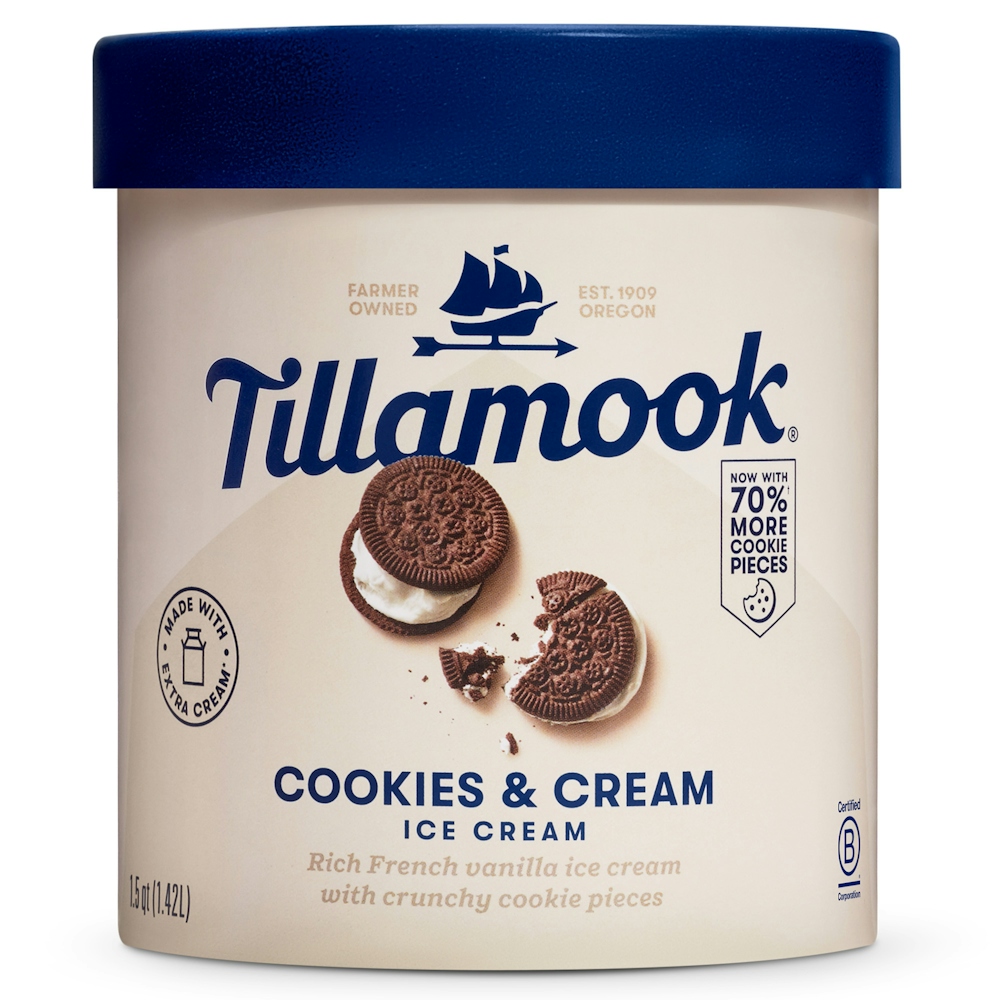
Tillamook
Tillamook Cookies And Cream Ice Cream, 48fl-oz
MILK · SUGAR · ENRICHED FLOUR
Standout ingredient: NIACIN
Analysis by Aurascan. Sources are listed on the product page.
Guess before you scroll
Quiz
Is Tillamook Cookies and Cream clean?
Guess before you scroll.
Reveal Aurascan's verdict
Aurascan says: Flagged
The main flag is MILK.
What Aurascan found on the printed carton?
Reading the fine print on a carton of Tillamook Cookies and Cream turns up roughly thirty listed entries. At first glance, a list that long can startle shoppers seeking whole, unadulterated foods. When deconstructed, however, the formula splits cleanly into three functional categories: a traditional dairy base, a multi-component baked cookie inclusion, and a plant-derived texture stabilizing system.
Unlike lower-tier frozen novelties that replace dairy fats with hydrogenated vegetable oils or water down their recipes with high-fructose corn syrup, this formulation adheres to traditional ice cream manufacturing. Most of the printed sub-ingredients belong to the baked cookie elements rather than the dairy base. Similar to comparisons we explored when asking Friendly's Orange Cream bars, scanned, evaluating a frozen treat requires separating foundational dairy nutrition from texture stabilizers and confection inclusions.
Does the dairy base meet federal ice cream standards?
The first four ingredients on the carton are cream, skim milk, milk, and sugar, followed closely by pasteurized egg yolks. In the United States, frozen desserts cannot simply call themselves ice cream on a whim. The Food and Drug Administration enforces a strict standard of identity under 21 CFR 135.110.
Under this federal regulation, finished ice cream must contain not less than 10 percent milkfat by weight, except when adding bulky flavoring ingredients like chocolate cookies, which allows a slight downward adjustment to an absolute floor of 8 percent milkfat. Products that fall short of this 10 percent dairy fat threshold must be labeled as frozen dairy dessert or light ice cream. Tillamook utilizes real cream and pasteurized egg yolks, producing an authentic custard profile without relying on skim milk solids mixed with cheap vegetable shortenings to simulate creaminess.
Pasteurized egg yolks supply natural lecithin, which binds milkfat droplets to water molecules, while pure vanilla extract provides foundational flavoring. For specific macronutrient details, such as total sugar, saturated fat, or sodium per serving, consumers should consult the printed Nutrition Facts panel on the container.
What ingredients hide inside the chocolate cookies?
The extensive middle section of the ingredient list belongs entirely to the dark sandwich cookies: enriched flour, water, palm oil, cocoa processed with alkali, soybean oil, palm and palm kernel oil, invert sugar, soy lecithin, salt, and baking soda. Each of these sub-ingredients serves a distinct baking purpose.
Enriched flour consists of refined wheat flour supplemented with niacin, reduced iron, thiamin mononitrate, riboflavin, and folic acid. Under federal enrichment standards, refined grain flours must replenish specific B vitamins and iron lost during the milling process to protect public health. While some clean-label shoppers prefer unbleached, unfortified whole grains, enrichment remains a standard regulatory requirement for commercial baked goods.
The cocoa powder in the cookie is processed with alkali, commonly known as Dutch processing. Treating raw cocoa beans with an alkaline solution reduces the natural acidity of cocoa, darkening its color to deep charcoal-brown and mellowing sharp, bitter astringency. Palm oil, palm kernel oil, and soybean oil provide solid plant fats necessary to give the cookie wafer its distinct snap and keep the cookie cream filling stable at sub-zero temperatures.
Invert sugar, a split mixture of glucose and fructose, retains moisture and prevents the baked cookie pieces from freezing into rock-hard ice cubes inside the frozen dairy medium. Similar principles govern the texture of commercial snack foods, as seen in our breakdown of the KIND Peanut Butter Dark Chocolate bar, scanned.
Why does Tillamook use a four-gum stabilizer system?
Toward the end of the ingredient list, you will notice four plant-derived gums: guar gum, tara gum, xanthan gum, and locust bean gum. Gums sit at the end of the list because they are used in very small amounts. Consumers frequently view gums with suspicion, but in frozen manufacturing, they solve a fundamental thermodynamic challenge known as heat shock.
Every time a home freezer door opens, internal temperatures rise slightly. Microscopic ice crystals inside the ice cream melt into liquid water. When the compressor kicks back on, that water refreezes. Without stabilizers, it fuses into jagged, crunchy ice shards that ruin the dessert's smooth mouthfeel.
- Guar gum: Derived from the seeds of the guar plant (Cyamopsis tetragonoloba), this water-soluble galactomannan polysaccharide hydrates rapidly in cold liquids, as characterized in PubChem compound records.
- Locust bean gum: Sourced from the carob tree (Ceratonia siliqua), it requires heat to activate and works synergistically with milk proteins to prevent liquid whey separation, also known as syneresis.
- Tara gum: Extracted from the seeds of the South American tara shrub (Caesalpinia spinosa), tara gum provides an intermediate viscosity profile bridging guar and locust bean gum.
- Xanthan gum: Produced by fermenting simple sugars with the bacterium Xanthomonas campestris, it imparts shear-thinning properties, ensuring the ice cream melts smoothly on the tongue.
The four gums work in synergy, which is why a blend appears instead of a single stabilizer at a higher dose.
Are the natural colorants and emulsifiers safe?
Color and emulsion integrity in Tillamook Cookies and Cream are achieved through time-tested natural additives: annatto extract and soy lecithin.
Annatto is a vibrant yellow-orange colorant extracted from the seed coats of the tropical achiote tree (Bixa orellana). Under FDA regulations, annatto is classified as a color additive exempt from batch certification. This contrasts sharply with petroleum-derived synthetic dyes, like Yellow 5 or Red 40, which require federal batch testing and face increasing consumer scrutiny. Natural colorants like annatto represent the exact class of plant-derived alternatives regulatory bodies and clean-label manufacturers are embracing across packaged foods.
Soy lecithin serves as a secondary emulsifier alongside the egg yolks. By acting as a bridge between the vegetable fats in the cookie pieces and the moisture in the ice cream base, soy lecithin ensures uniform chocolate distribution and helps cookie wafers retain their structural integrity without softening into soggy batter.
One clear limitation in scientific literature involves personal digestive responses: current nutritional evidence cannot establish absolute tolerance thresholds for every individual. While regulatory bodies consider botanical gums and natural color extracts safe for the broad public, individuals with heightened gastrointestinal sensitivities or specific legume cross-reactivities may experience mild digestive variability when consuming high-fiber hydrocolloid blends.
What to look for on the label
When evaluating any cookies and cream ice cream in the supermarket aisle, use this checklist to assess formulation quality:
- Standard of Identity: Check whether the package legally states "Ice Cream" or defaults to "Frozen Dairy Dessert." Real ice cream guarantees at least 10 percent milkfat.
- Fat Sources: Look for dairy fat (cream, whole milk, egg yolks) listed at the very top. Vegetable oils should appear only inside parenthetical sub-ingredients for inclusions like baked cookies.
- Coloring Sources: Look for certified-exempt natural plant extracts such as annatto, carotene, or vegetable juice rather than artificial dyes like Yellow 5, Yellow 6, or Blue 1.
- Stabilizer Types: Note the presence of natural seed gums (guar, locust bean, tara) versus synthetic emulsifiers like polysorbate 80 or monoglycerides.
- Sweeteners: Check whether the base utilizes cane sugar and egg yolks rather than high-fructose corn syrup.
Aurascan is a free food-label scanner app currently in beta (available via iOS TestFlight, with a waitlist for other platforms). Rather than assigning an arbitrary, black-box numerical score, Aurascan analyzes labels ingredient by ingredient with cited regulatory and scientific evidence, pulling verified data from Open Food Facts, the USDA, and global barcode registries. Every citation is checked by an automated verifier, categorizing ingredients as Clean, Mixed, or Flagged without commercial sponsors. Download Aurascan today to scan your favorite cartons and discover exactly what lies behind the fine print.
Try Aurascan
See what is really in the food you buy.
Common questions
- Is Tillamook Cookies and Cream real ice cream?
- Yes. Tillamook Cookies and Cream satisfies the FDA standard of identity under 21 CFR 135.110, containing at least 10 percent milkfat derived from real cream and milk, rather than vegetable oil substitutes.
- Why does Tillamook Cookies and Cream contain palm oil?
- Palm oil and palm kernel oil are used exclusively inside the baked chocolate sandwich cookie inclusion to provide structure and stability at freezing temperatures, not in the dairy ice cream base.
- What is annatto and why is it in vanilla-based ice cream?
- Annatto is a natural colorant extracted from achiote seeds. It is an FDA certified-exempt color additive used to impart a subtle, warm cream hue to the dairy base without synthetic dyes.
- Why are there four different gums in this ice cream?
- Guar gum, tara gum, xanthan gum, and locust bean gum work together synergistically at less than 0.5 percent total weight to bind water molecules, preventing large ice crystals from forming during home freezer temperature fluctuations.
- Does Tillamook Cookies and Cream contain bioengineered ingredients?
- The sandwich cookies contain enriched wheat flour, soy lecithin, and cornstarch, which may be derived from conventional crops; consumers can check the package label for specific disclosure statements.
- Is the cocoa in the cookies natural or alkalized?
- The cookies use cocoa processed with alkali (Dutch-processed), which neutralizes natural cocoa acidity, softens bitterness, and darkens the cookie pieces to a deep chocolate color.
Sources
- 21 CFR 135.110 - Ice Cream Standard of Identity (law.cornell.edu)
- Compound Summary: Guar Gum (pubchem.ncbi.nlm.nih.gov)
- Food Additive Status List (fda.gov)
- Color Additives Questions and Answers for Consumers (fda.gov)
In this series
Guide
Is Fanta Orange Clean? Every Ingredient, ScannedGuide
Are Friendly's Orange Cream Bars Clean? Every Ingredient, ScannedGuide
Is Dole 100% Pineapple Juice Clean? The Label, ScannedGuide
Is Fage Total 0% Clean? A Two-Line Yogurt Label, ScannedGuide
Are Pringles Hot Honey Clean? Every Ingredient, ScannedGuide
Is Sprite Clean? Every Ingredient in the Can, Scanned
Related guides
Product Education
Is Tillamook Cookie Dough Ice Cream Clean? 25 Ingredients, ScannedTillamook Chocolate Chip Cookie Dough lists 25 ingredients, most of them cookie dough. Which are dairy, which are dough, and where the gums and lecithin come in.
Product Education
Are Stacy's Pita Chips Clean? Every Ingredient, ScannedEnriched wheat flour, sunflower and/or canola oil, two Parmesans and a 2-percent tail with rosemary extract. Stacy's Parmesan Garlic and Herb pita chips, line by line.
Product Education
Is Frigo String Cheese Clean? Four Ingredients, ScannedPasteurized part-skim milk, cheese cultures, salt, enzymes. What the FDA standard for low-moisture mozzarella requires, and what 'enzymes' hides on a cheese label.
Try it on your own groceries
Scan your next label with Aurascan
Point the camera at any ingredient list and get the same evidence-graded read you see here.
Open the scannerLabel-reading intel, weekly.
What changed on food labels this week — bans, recalls, and new guides.