
Comparisons · September 20, 2026 · 8 min read
Dole Pineapple Juice vs Fanta Pineapple: 4 Ingredients vs 13
One is juice plus three vitamins, the other is soda with two dyes, two preservatives and a clouding system. What each label proves, and what it hides about sugar.
By Chris Carrillo · Reviewed by Armin Rad, Co-Founder & CTO, Aurascan · September 20, 2026
Every article is checked against primary sources before publication. How we review
Choose Dole 100% Pineapple Juice if you want real fruit without synthetic dyes, preservatives, or artificial clouding agents. If your primary goal is managing sugar, neither is low-sugar. Dole contains zero added sugars but delivers concentrated natural free sugars, whereas Fanta Pineapple is an engineered soft drink formulated with high fructose corn syrup.
Key takeaways:
- Dole 100% Pineapple Juice contains only pineapple juice and added vitamins, avoiding the preservatives, synthetic dyes, and stabilizing agents found in Fanta Pineapple.
- Fanta Pineapple relies on sucrose acetate isobutyrate (SAIB), medium-chain triglycerides (MCT), and modified food starch to mechanically recreate the cloudy texture naturally present in real fruit juice.
- While Dole contains zero grams of Added Sugars on its Nutrition Facts label, 100 percent juice remains a concentrated source of naturally occurring free sugars that pediatric and dietary guidelines advise limiting.
- Fanta Pineapple uses certified synthetic colors Yellow 5 and Yellow 6, alongside potassium sorbate and sodium benzoate to stabilize flavor and shelf life.
As of September 2026, the comparison between Dole 100% Pineapple Juice and Fanta Pineapple highlights the stark difference between a standardized fruit beverage and an engineered carbonated soft drink. Examining the ingredient panels reveals distinct manufacturing goals, from visual turbidity systems to preservation techniques.
How Do Dole Pineapple Juice and Fanta Pineapple Compare at a Glance?
| Feature | Dole 100% Pineapple Juice (46 fl oz can) | Fanta Pineapple Soda (12 fl oz can) |
|---|---|---|
| Total Ingredients | 4 | 13 |
| Primary Base | Pineapple juice | Carbonated water |
| Sweetening Agent | Naturally occurring fruit sugars | High fructose corn syrup |
| Color Sources | Natural pineapple color | Yellow 5 (Tartrazine), Yellow 6 |
| Preservatives | None | Potassium sorbate, sodium benzoate |
| Clouding / Texture System | Natural fruit solids | Modified food starch, MCT, SAIB |
| Added Vitamins | Vitamin C (ascorbic acid), Vitamin E, Vitamin A | None |
| Added Sugars (Label) | 0 g Added Sugars | Sweetened with added caloric syrup |
Quiz
Which has the cleaner label: Dole Pineapple Juice or Fanta Pineapple?
Guess before you scroll.
Reveal Aurascan's verdict
Aurascan says: It's a tie
What Are the Real Differences Between the Two Ingredient Lists?
Reading the ingredient statements side by side illustrates two fundamentally different philosophies of beverage formulation. Dole 100% Pineapple Juice lists four ingredients:
- Pineapple juice
- Ascorbic acid (vitamin C)
- Vitamin E
- Vitamin A
In contrast, Fanta Pineapple lists thirteen ingredients:
- Carbonated water
- High fructose corn syrup
- Citric acid
- Natural flavors
- Modified food starch
- Potassium sorbate (to protect taste)
- Sodium benzoate (to protect taste)
- Sodium citrate
- Medium chain triglycerides
- Salt
- Sucrose acetate isobutyrate
- Yellow 5
- Yellow 6
For a broader look at how simple ingredient statements operate, see our review on how Is Häagen-Dazs Chocolate Clean? Five Ingredients, Scanned. In Dole's can, the base is entirely juice. Ascorbic acid is introduced both as a nutrient and as an antioxidant to control enzymatic browning, while vitamins A and E serve as micronutrient fortification. Fanta, by contrast, builds a facsimile of pineapple flavor, acidity, color, and mouthfeel from scratch using water, acidulants, chemical stabilizers, and artificial colorings. For another stark formulation contrast in commercial carbonated sodas, read our comparison on Fanta Orange vs Sprite: Why One Has Dyes and One Doesn't.
Scan preview
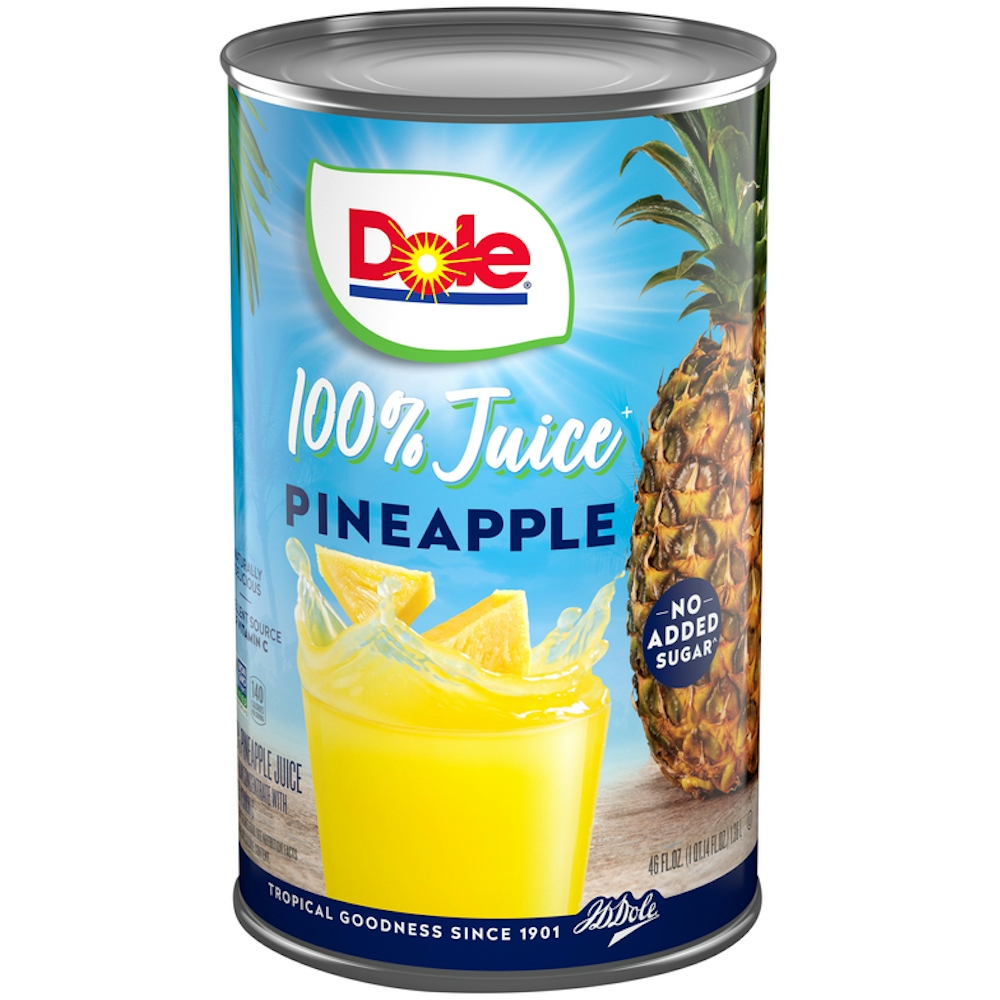
Dole
Dole 100% Pineapple Juice - 46 Fl Oz Can
Vitamin E · Vitamin A · Pineapple Juice
Standout ingredient: Ascorbic Acid (Vitamin C)
Analysis by Aurascan. Sources are listed on the product page.
How Does Fanta Use Weighting Agents to Replicate Juice Cloudiness?
Freshly squeezed or reconstituted pineapple juice is naturally cloudy due to insoluble plant solids, pectins, and cellular pulp suspended in the liquid. A clear carbonated beverage would visually look like lemon soda rather than pineapple. To mimic the appearance of real juice, Fanta Pineapple employs a complex emulsion system involving modified food starch, medium-chain triglycerides (MCT), and sucrose acetate isobutyrate (SAIB).
Flavor oils and colorants are naturally lighter than water and tend to float to the top of a bottle over time, a process known as "ringing." To counteract this, food chemists use weighting agents like SAIB and neutral carrier oils like MCT to increase the specific gravity of the oil droplets, matching them to the density of the surrounding carbonated water. When paired with modified food starch, which functions as an emulsifier and hydrocolloid stabilizer, these microscopic oil droplets remain suspended indefinitely, scattering light and creating a perpetual artificial turbidity or "cloud."
In our detailed look at Is Fanta Pineapple Clean? Every Ingredient, Scanned, we examine how these weighting compounds allow industrial soft drinks to mimic natural fruit visual density without including any actual fruit flesh or pulp. Understanding these formulation tricks helps explain why scanning food labels line by line is crucial for deciphering industrial textures.
Scan preview

Fanta
Fanta Pineapple Soda Bottles
High Fructose Corn Syrup · Natural Flavors · Medium Chain Triglycerides
Standout ingredient: Carbonated Water
Analysis by Aurascan. Sources are listed on the product page.
Why Does Fanta Contain Yellow 5, Yellow 6, and Preservatives?
Dole achieves its golden-yellow hue strictly from natural pigments present in the pineapple fruit itself, such as carotenoids. Fanta Pineapple contains no juice and relies instead on two petroleum-derived certified synthetic food dyes: FD&C Yellow No. 5 (tartrazine) and FD&C Yellow No. 6.
Under FDA regulations, Yellow 5 requires specific disclosure by name on ingredient labels because a small fraction of the population experiences allergic-type reactions such as hives. Synthetic food dyes have faced increased scrutiny since April 2025, when HHS and the FDA announced a plan to phase petroleum-based dyes out of the food supply and the FDA began tracking company pledges. To understand how colorant policies are shifting industry formulations, read our coverage on Skittles and M&M's Without FD&C Colors: What Changed on the Label, as well as our review of 5 Snacks and Sodas Scanned for Artificial Dyes.
Fanta also incorporates two common antimicrobial preservatives: potassium sorbate and sodium benzoate, labeled explicitly "to protect taste." These agents inhibit the growth of mold, yeast, and bacteria in high-moisture, ambient-shelf environments. Canned juice is kept stable by heat processing and the sealed can rather than by chemical preservatives. If you want to understand how European authorities classify these functional additives, check out our guide on E Numbers Explained: The EU Code for US Additives.
How Do Natural Fruit Sugars Compare to High Fructose Corn Syrup?
A critical distinction between these two beverages lies in how their sugars are categorized on the mandatory Nutrition Facts label. Dole contains no refined sugars or syrups; its panel reflects naturally occurring fruit sugars, meaning it lists zero grams of "Added Sugars." Fanta Pineapple, on the other hand, is sweetened entirely with high fructose corn syrup (HFCS), which is classified as an added sugar. The regulatory context of this sweetener is detailed in the FDA High Fructose Corn Syrup Questions and Answers.
However, consumers should not assume that "no added sugar" means "low sugar." When fruit is juiced, its insoluble dietary fiber is stripped away, turning the intrinsic sugars of the whole fruit into concentrated "free sugars." These free sugars arrive without the fiber of whole fruit, which is why dietary guidance treats juice more like a sugary drink than like fruit.
Public health authorities, such as the CDC on sugar-sweetened beverages and health and the 2025-2030 Dietary Guidelines for Americans, emphasize that excess consumption of both added sugars and free sugars contributes to dental caries and metabolic strain. For insight into what federal dietary revisions reveal about modern packaged foods, see our report on Dietary Guidelines Name 4 Things No Food Label Shows. For younger populations, the American Academy of Pediatrics specifically recommends strict daily limits on 100 percent fruit juices, advising against any juice for infants under one year old and recommending no more than four to eight ounces per day for older children, depending on age. Always consult the Nutrition Facts label for exact Total Sugar and serving size information on both cans.
What Are the FDA Standards for 100% Juice Versus Fruit Soda?
The standard of identity for fruit beverages is tightly policed by federal regulation. Under 21 CFR 101.30, any beverage that purports to contain fruit juice must prominently declare the total percentage of juice on the information panel. For a brand to claim "100% Juice" on the principal display panel, the beverage must consist entirely of pure fruit juice or juice concentrate reconstituted with water to standard Brix levels, without dilution from non-juice liquids.
Pineapple juice identity standards under 21 CFR 146.185 permit the addition of optional nutritive sweeteners and antioxidant additives like ascorbic acid. Depending on production runs and packaging runs, commercial pineapple juice may be packed directly from fresh fruit ("not from concentrate") or reconstituted from concentrated juice ("from concentrate"). Consumers should inspect the panel directly to verify processing methods.
Fanta Pineapple, by contrast, is classified simply as a flavored, carbonated soft drink. Because it contains no natural juice, it is not subject to percentage juice declaration rules, but must identify its flavor profile as "natural flavors" alongside its synthetic colorants. For broader techniques on parsing ingredient declarations, check out How to Read a Food Label: The Ingredient List, Line by Line.
Evidence cannot establish universal personal tolerance for every consumer; individuals may react idiosyncratically to specific food additives like sulfites, benzoates, or synthetic food colorings, while others may experience glycemic spikes regardless of whether sugar originates from corn starch or whole pineapples.
Which Should You Pick for Refreshment, Nutrition, or Children?
Choosing between these two beverages comes down to dietary goals, additive tolerance, and specific usage contexts:
- Choose Dole 100% Pineapple Juice if: You prioritize minimal processing, want to avoid artificial food dyes like Yellow 5 and Yellow 6, and seek genuine fruit micronutrients including naturally occurring potassium and added vitamins C, E, and A.
- Choose Fanta Pineapple if: You are seeking a carbonated, highly effervescent soda experience and are unconcerned with added caloric sweeteners or synthetic coloring agents.
- For Children: Both beverages warrant portion caution. While Dole offers nutrient fortification and avoids chemical dyes, pediatric groups advise treating juice as an occasional limited treat rather than a primary hydration beverage, preferring whole fruit and water instead.
Before you purchase your next canned drink, take a moment to evaluate the label directly. Aurascan is a free food-label scanner app currently in beta on iOS TestFlight and waitlist. It pulls data directly from Open Food Facts, the USDA, and barcode databases, with scientific citations checked by an automated verifier. Aurascan delivers per-ingredient Clean, Mixed, or Flagged verdicts without arbitrary numeric scores or corporate sponsors, making label transparency effortless.
Try Aurascan
See what is really in the food you buy.
Common questions
- Does Dole 100% Pineapple Juice have added sugars?
- No, Dole 100% Pineapple Juice contains no added refined sugars or syrups, and its Nutrition Facts panel lists 0 g Added Sugars. However, it naturally contains fruit sugars.
- Why does Fanta Pineapple need weighting agents like SAIB and MCT?
- Fanta Pineapple uses sucrose acetate isobutyrate (SAIB), medium-chain triglycerides (MCT), and modified food starch to keep flavor oils suspended and create a cloudy appearance that visually mimics natural fruit juice.
- What is the role of ascorbic acid in Dole Pineapple Juice?
- Ascorbic acid provides vitamin C fortification and acts as a food-grade antioxidant to prevent the natural pineapple juice from browning or degrading in flavor over time.
- Why is Yellow 5 specifically listed on the Fanta Pineapple can?
- The FDA mandates that Yellow 5 (tartrazine) be declared by name on food labels because a subset of the population experiences allergic-like sensitivities or intolerances to it.
- Is 100% fruit juice considered healthier for kids than soda?
- While 100% juice provides vitamins and avoids synthetic dyes, pediatric authorities such as the American Academy of Pediatrics recommend limiting juice intake for children because its concentrated free sugars lack dietary fiber.
- What is the regulatory difference between 100% juice and fruit-flavored soda?
- Under FDA 21 CFR 101.30, 100% juice must be derived entirely from fruit without non-juice dilution and must declare juice percentages, whereas fruit-flavored soda contains no juice and is regulated as a flavored carbonated beverage.
Sources
- High Fructose Corn Syrup Questions and Answers (fda.gov)
- 21 CFR 146.185 - Canned pineapple juice (law.cornell.edu)
- Sugar-Sweetened Beverages and Health (cdc.gov)
- Added Sugars on the Nutrition Facts Label (fda.gov)
- Tracking Food Industry Pledges to Remove Petroleum-Based Food Dyes (fda.gov)
In this series
Guide
Fanta Orange vs Sprite: Why One Has Dyes and One Doesn'tGuide
Is SkinnyPop Clean? Three Ingredients, ScannedGuide
Is Häagen-Dazs Chocolate Clean? Five Ingredients, ScannedGuide
Is Fanta Pineapple Clean? Every Ingredient, ScannedGuide
Skittles and M&M's Without FD&C Colors: What Changed on the LabelGuide
England Bans Energy Drinks for Under-16s. US Labels Hide Caffeine
Related guides
Comparisons
RYSE Loaded Protein vs Core Power: Powder vs Shake, Label by LabelBoth lean on sucralose, acesulfame K and carrageenan, but one is whey powder with MCT and inulin, the other ultra-filtered milk. Compared amid the heavy-metal debate.
Ingredient Reviews
Sodium Phosphate in Food: Who Actually Needs to Worry?Sodium phosphate is in boxed mac and cheese, deli chicken and cereal. What FDA and EFSA say, the kidney evidence, and how to spot it.
Ingredient Reviews
Annatto: The Seed Color in Cheese and SnacksAnnatto (E 160b) is a seed-based orange color used in cheddar, butter and snacks. What FDA and EFSA allow, the ADIs, and rare allergy reports.
Try it on your own groceries
Scan your next label with Aurascan
Point the camera at any ingredient list and get the same evidence-graded read you see here.
Open the scannerLabel-reading intel, weekly.
What changed on food labels this week — bans, recalls, and new guides.