
Guides · October 25, 2026 · 8 min read
How Much Added Sugar Should Kids Have a Day? By Age, in Grams
Under 25 g a day for ages 2 to 18 and none before age 2, says the AHA. Why a kids' cereal's 24% DV on the label is about half that limit.
By Chris Carrillo · Reviewed by Armin Rad, Co-Founder & CTO, Aurascan · October 26, 2026
Every article is checked against primary sources before publication. How we review
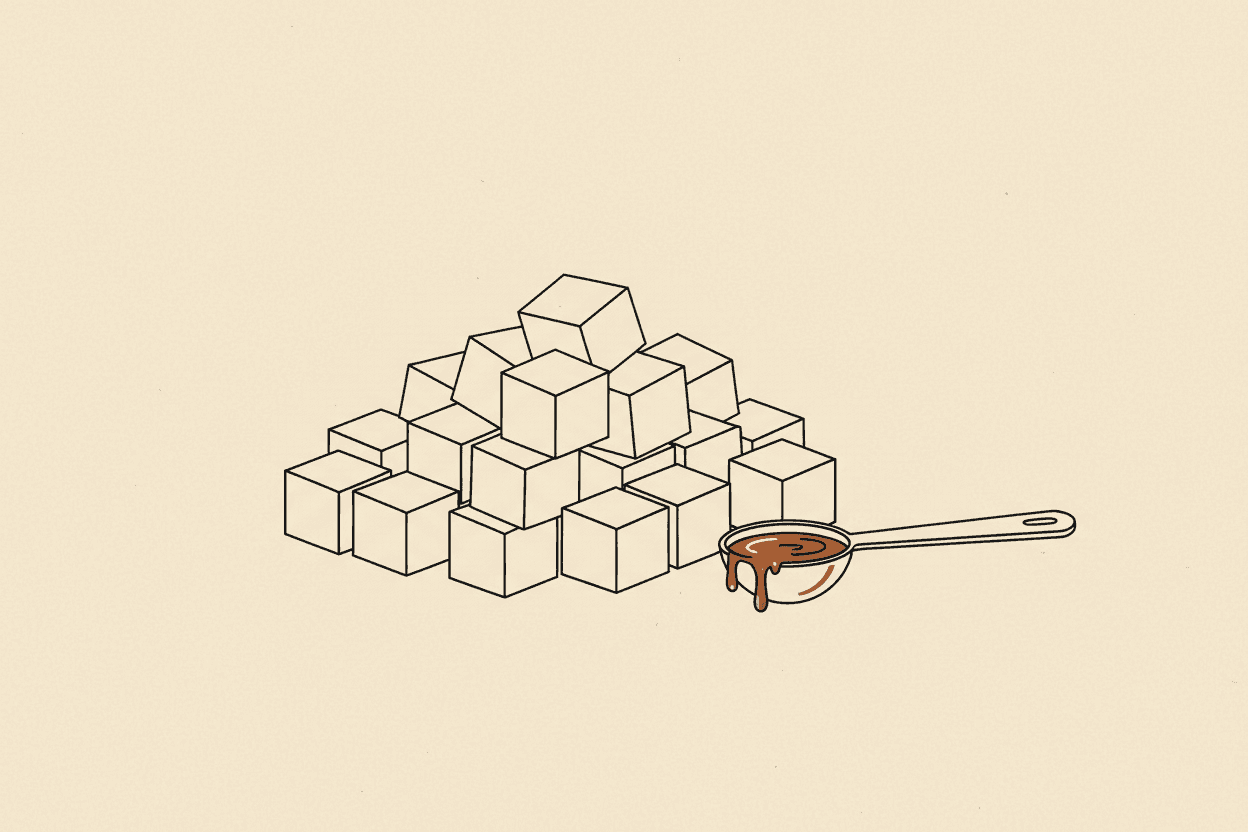
The American Heart Association recommends that children ages 2 to 18 have 25 grams or less of added sugar per day, about 100 calories or about 6 teaspoons. Children under 2 should avoid added sugars. The 2025-2030 Dietary Guidelines for Americans cap any single meal at 10 grams of added sugar. On a Nutrition Facts label, the added-sugars Daily Value uses 50 grams for ages 4 and up, so 50% DV equals the entire AHA daily limit for a child.
Key takeaways
- The AHA ceiling for ages 2 to 18 is 25 g of added sugar per day (about 100 calories, about 6 teaspoons). Children under 2 should avoid added sugars.
- On labels for ages 4 and up, the added-sugars %DV uses 50 g, so 50% DV equals 25 g. Foods labeled for ages 1 to 3 use a 25 g reference.
- Honey Nut Cheerios (1 cup, 140 calories) lists 12 g added sugars, which is 48% of the AHA's 25 g cap.
- The 2025-2030 guidelines advise avoiding added sugars in early childhood, recommend no amount for ages 5 to 10, and significantly limit sugary drinks for ages 11 to 18.
- Added sugars appear under many names, including high-fructose corn syrup, agave syrup, rice syrup, dextrose, cane sugar, fruit juice concentrate, honey and molasses.
How much added sugar should kids have a day?
Children ages 2 to 18 should have 25 grams or less of added sugar per day, according to an American Heart Association scientific statement. That works out to about 100 calories, or roughly 6 teaspoons.
The statement's evidence review links added sugars to cardiovascular risk factors, including energy intake, adiposity and dyslipidemia.
The statement's NHANES 2009-2012 table reported mean added-sugar intake of 53.3 g/day at ages 2 to 5, 78.7 g/day at ages 6 to 11 and 93.9 g/day at ages 12 to 19. Each of those averages is above the 25 gram ceiling. These figures are from 2009-2012, so current intake may differ.
How much added sugar can a toddler have per day?
The AHA advises that children under 2 avoid added sugars, and no gram allowance is given for that age group. The 2025-2030 Dietary Guidelines give the same direction for infancy and early childhood, which they define as birth through 4 years.
Parents often look for a toddler number, and the guidance does not supply one. The Nutrition Facts label is a separate matter. The added-sugars Daily Value does not apply to infants under the rules in 21 CFR 101.9. Foods labeled for children 1 through 3 use a 25 gram reference under the same regulation. That reference is a labeling standard, not a recommended intake.
A toddler's needs depend on age, diet and health, and this article cannot judge what any individual child should eat. Questions about a specific child are best taken to a pediatric clinician.
How many grams of added sugar for kids?
For children ages 2 to 18, the AHA limit is 25 grams of added sugar per day, about 100 calories or about 6 teaspoons. The same statement recommends that children and adolescents have 1 or fewer 8-ounce sugar-sweetened drinks per week, a Class I recommendation with Level of Evidence A.
The Dietary Guidelines do not give a gram figure for ages 11 to 18. They say to significantly limit sugary drinks and energy drinks.
The Nutrition Facts panel is the easiest place to count. The Added Sugars line sits beneath Total Sugars, and it is the figure to compare against the child limit.
How much sugar should a child have a day by age group?
The AHA sets one 25 gram ceiling for ages 2 to 18. The 2025-2030 Dietary Guidelines add stricter wording by age band:
- Birth to 4 years: avoid added sugars during infancy and early childhood.
- 5 to 10 years: no amount of added sugars is recommended, and caffeinated beverages should be avoided.
- 11 to 18 years: significantly limit sugary drinks and energy drinks.
The AHA figure and the guidelines answer different questions. The AHA sets a daily ceiling for ages 2 to 18, while the guidelines describe the direction of advice for each age band, with the strictest wording for younger children.
How do the 2025-2030 Dietary Guidelines per-meal 10 g cap change the daily math?
The guidelines set a cap of no more than 10 grams of added sugars in one meal. That cap equals 20% of the 50 gram label reference and 40% of the AHA's 25 gram daily limit.
The guidelines state the cap per meal and do not state a whole-day total. Parents should therefore treat the meal cap and the daily AHA ceiling as two separate checks on the same foods.
Honey Nut Cheerios shows why the check matters. One 1-cup serving lists 12 grams of added sugars, which is more than the 10 gram per-meal cap before milk or fruit is added. Serving size matters, since the label figure applies to the listed serving and not necessarily to the amount a child eats.
Why does a 50 g Daily Value make a 25 g child limit hard to read on labels?
On foods labeled for ages 4 and up, the added-sugars %DV is calculated on 50 grams, so 50% DV equals 25 grams, which is the full AHA daily limit for a child. A 100% DV would equal 50 grams, twice the cap.
FDA's consumer page states the 50 gram Daily Value, which is based on a 2,000-calorie reference. Because the percentage uses a larger number than the child limit, a figure that looks modest can represent a large share of a child's day.
Honey Nut Cheerios illustrates this. Its label lists 12 grams of total sugars, includes 12 grams of added sugars and shows 24% DV per 1 cup serving of 140 calories. The 12 grams is 48% of the AHA's 25 gram cap. FDA says added sugars do not include naturally occurring sugars in milk, fruits and vegetables, so the Added Sugars line is the one to compare. For a side-by-side look at the two cereals, see Cheerios vs Honey Nut Cheerios: How Much Sugar? 2 g vs 12 g.
What added sugar names should parents look for on kids' food labels?
The 2025-2030 Dietary Guidelines list high-fructose corn syrup, agave syrup, rice syrup, dextrose, cane sugar, fruit juice concentrate, honey and molasses as added-sugar names. They also advise looking for ingredients that include the word "sugar" or "syrup" or end in "-ose", a check that would still miss honey, molasses and fruit juice concentrate.
A practical checklist:
- High-fructose corn syrup
- Agave syrup
- Rice syrup
- Dextrose
- Cane sugar
- Fruit juice concentrate
- Honey
- Molasses
Use the Added Sugars line for the total and the ingredient list to see which names are used.
Which kids' foods and sweetened categories carry the most added sugar?
The guidelines single out sugar-sweetened beverages, including sodas, fruit drinks and energy drinks, for avoidance. They also set snack limits: grain snacks such as crackers should not exceed 5 grams of added sugar per 3/4-ounce whole-grain equivalent, and dairy snacks such as yogurt should not exceed 2.5 grams per 2/3-cup equivalent. Check the serving size on the panel before comparing these products with the child limit.
The guidance does not quantify other product categories in this article's scope, so check each panel rather than assuming a category is low or high in sugar.
How do you compare kids' products by added sugar per serving and %DV?
Compare grams of added sugars per listed serving first, then judge that number against the 25 gram AHA limit or the 10 gram meal cap. Use %DV only after you know which reference it uses.
- Find the Added Sugars line, not only Total Sugars.
- Check the serving size and how much a child is likely to eat.
- Compare the result with the 10 gram per-meal ceiling and the 25 gram daily limit.
- Foods labeled for ages 4 and up use a 50 gram %DV, so 50% DV equals 25 grams.
- Foods labeled for children 1 to 3 use a 25 gram DV, so for a 2- or 3-year-old their %DV equals the share of the AHA limit directly. The DV reference is set in 21 CFR 101.9.
Are sugar alternatives and non-nutritive sweeteners a safe swap for kids?
Not by the Dietary Guidelines' standard: the 2025-2030 guidelines say no amount of added sugars or non-nutritive sweeteners is recommended, so a zero-sugar label does not by itself show that a product fits the guidance for children.
Non-nutritive sweeteners appear on labels under several names. The guidance cited here does not include regulator safety findings for these sweeteners in children, so that question is not settled in this article. For related reading, see Oikos Triple Zero vs Chobani Zero Sugar: Stevia or Allulose? and Sweetener Stacks: 4 Scanned Drinks That Blend Sweeteners.
The evidence has clear limits. Population-level research does not show how a specific child will respond to a given intake, and long-term data on non-nutritive sweeteners in children are not covered here.
Scan your next label with Aurascan, a food-label scanner app for iPhone with a free tier, and compare the Added Sugars line with the limits above.
Related reading: see how two kids' yogurts compare in Which Has More Added Sugar, Go-Gurt or Danimals?
Try Aurascan
See what is really in the food you buy.
Common questions
- How much added sugar can a toddler have per day?
- The AHA advises that children under 2 avoid added sugars, so it sets no daily gram allowance for toddlers. The 2025-2030 Dietary Guidelines likewise advise avoiding added sugars during infancy and early childhood, which they define as birth through 4 years. The 25 gram reference on labels for ages 1 to 3 is a labeling standard, not a recommended intake.
- How much added sugar is OK for kids?
- For children ages 2 to 18, the American Heart Association recommends 25 grams or less of added sugar per day, about 100 calories or 6 teaspoons. The AHA also recommends 1 or fewer 8-ounce sugar-sweetened drinks per week for children and adolescents. The 2025-2030 Dietary Guidelines do not give a gram limit for ages 11 to 18.
- How many teaspoons of sugar should a child have a day?
- A child ages 2 to 18 should have about 6 teaspoons, or 25 grams, of added sugar or less per day, according to the AHA. That limit counts added sugars only, not the naturally occurring sugars in milk, fruits and vegetables.
- How much sugar should a child have daily?
- For ages 2 to 18, the AHA ceiling is 25 grams of added sugar per day, and children under 2 should avoid added sugars. The 2025-2030 Dietary Guidelines for Americans add stricter wording for younger children and cap any single meal at 10 grams of added sugar.
- Does 50% DV on a kids' label mean half the daily limit?
- No. On foods labeled for ages 4 and up, 50% DV equals 25 grams of added sugars, which is the full AHA daily limit for a child. Because the reference is 50 grams, every 10% DV equals 5 grams.
- Does 100% fruit juice count toward the AHA 25 gram limit?
- The AHA and Dietary Guidelines passages used for this article do not say how 100% fruit juice counts against the 25 gram limit. A pediatric clinician can help with a specific child's diet.
Sources
- Added Sugars and Cardiovascular Disease Risk in Children (AHA scientific statement) (pmc.ncbi.nlm.nih.gov)
- Dietary Guidelines for Americans 2025-2030 (cdn.realfood.gov)
- 21 CFR 101.9 Nutrition labeling of food, Daily Value for added sugars (ecfr.gov)
- Added Sugars on the Nutrition Facts Label (fda.gov)
- Honey Nut Cheerios product label (cheerios.com)
In this series
Guide
Which Has More Sugar, Smucker's or Welch's Grape Jelly? Both 9g AddedGuide
Does Mrs. Butterworth's Have HFCS? Yes; Log Cabin Uses Corn SyrupGuide
Does Sweet Baby Ray's Have HFCS? Yes, and So Does KraftGuide
Oikos Triple Zero vs Chobani Zero Sugar: Stevia or Allulose?Guide
Heinz vs Hunt's Ketchup: 4 g vs 3 g Added SugarGuide
Cheerios vs Honey Nut Cheerios: How Much Sugar? 2 g vs 12 g
Related guides
Comparisons
Does Prego Have Added Sugar? Yes, 4 g vs Ragú's <1 gPrego Traditional lists 4 g added sugar per 1/2 cup; Ragú Old World Style Traditional lists under 1 g. Sodium, oil and ingredient order compared.
Comparisons
Do Stauffer's Animal Crackers Have HFCS? Barnum's Don'tStauffer's Original Animal Crackers list high fructose corn syrup; Barnum's list sugar, dextrose and fructose. Both carry 7g added sugars per serving.
Comparisons
Which Has More Fiber, Metamucil or Benefiber? 6 g EachBoth labels list 6 g fiber per serving. Metamucil is psyllium (5 g soluble) with aspartame or 16 g sugar plus Yellow 6; Benefiber is just wheat dextrin (6 g soluble).
Try it on your own groceries
Scan your next label with Aurascan
Point the camera at any ingredient list and get the same evidence-graded read you see here.
Open the scannerGet food recall alerts + a weekly digest
An email when a food recall is announced, plus one weekly roundup of label news and new guides.
We email a confirmation link first - nothing is sent until you click it. Unsubscribe anytime. Privacy