
Comparisons · October 5, 2026 · 7 min read
Fanta Orange vs Friendly's Orange Cream: Two Yellow 6 Labels
Both list Yellow 6. We compare Fanta Orange and Friendly's Orange Cream bars on dyes, real orange, sweeteners, preservatives and what US and EU rules say.
By Chris Carrillo · Reviewed by Armin Rad, Co-Founder & CTO, Aurascan · October 5, 2026
Every article is checked against primary sources before publication. How we review
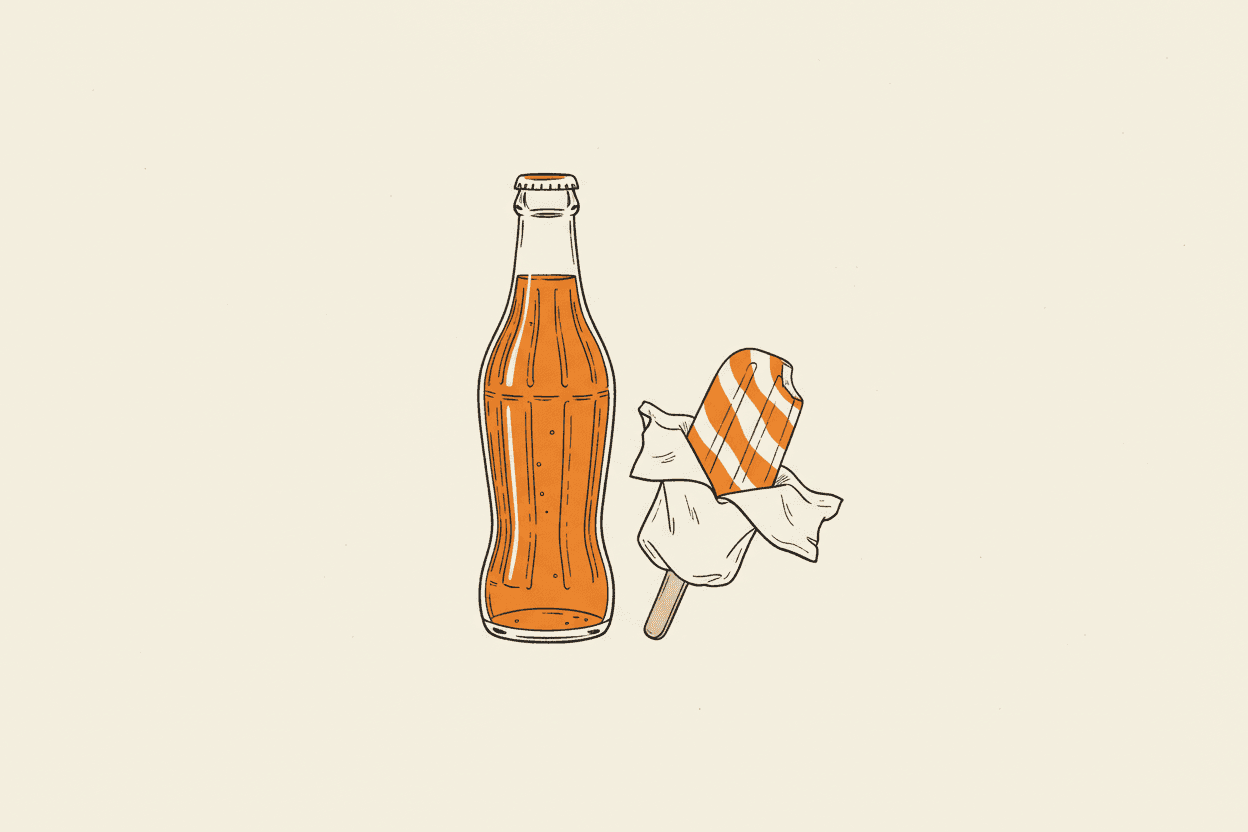
Fanta Orange and Friendly's Orange Cream bars both list Yellow 6, but their Open Food Facts listings differ on almost everything else: Fanta adds a second certified dye (Red 40) and a preservative (sodium benzoate), while Friendly's lists real orange ingredients, a milk base and a longer list of stabilizers. This is a label comparison, not a verdict on which one is healthier.
Key takeaways
- Both products list certified Yellow 6 at the very end of their descending-weight ingredient lists, and Fanta also lists Red 40.
- Friendly's uses orange pulp and concentrated orange juice, whereas Fanta's Open Food Facts listing relies entirely on unspecified natural flavors.
- Fanta lists the preservative sodium benzoate plus glycerol ester of rosin, while Friendly's lists no preservative but has a longer stabilizer list (guar gum, mono and diglycerides, carob bean gum, cellulose gum, carrageenan and pectin).
- Yellow 6 and Red 40 require batch certification in the United States, while the European Union mandates an attention and activity warning for foods containing these synthetic dyes.
Fanta Orange vs Friendly's Orange Cream Bars: At-a-Glance Comparison
Comparing Fanta Orange soda and Friendly's Orange Creme ice cream bars reveals two distinct approaches to achieving an orange-flavored, citrus-colored treat. Fanta is a carbonated soft drink with nine listed ingredients, while Friendly's is a frozen, milk-based bar with twenty listed ingredients.
Neither product uses a "contains 2% or less" statement in its Open Food Facts listing, indicating that all ingredients appear in strict descending order by weight.
| Attribute | Fanta Orange Soda | Friendly's Orange Cream Bars |
|---|---|---|
| Barcode | 049000019162 | 029839100170 |
| Total Ingredients | 9 ingredients | 20 ingredients |
| Color Additives | Yellow 6, Red 40 | Yellow 6 |
| Orange Sourcing | Natural flavors (source not disclosed) | Orange pulp, concentrated orange juice |
| Primary Sweeteners | High fructose corn syrup | Sugar, corn syrup, high fructose corn syrup |
| Preservatives | Sodium benzoate | None listed |
| Stabilizers & Emulsifiers | Modified food starch, glycerol ester of rosin | Guar gum, mono and diglycerides, carob bean gum, cellulose gum, carrageenan, pectin |
| Dairy Base | None listed | Milk, cream, skim milk solids, whey |
Quiz
Both list Yellow 6 as a color. Which one adds a second certified dye, Red 40?
Guess before you scroll.
Reveal Aurascan's verdict
Aurascan says: It's a tie
Yellow 6 and Red 40: How the Color Additives Compare
In both Open Food Facts listings, the certified dyes are the last ingredients. Friendly's lists only Yellow 6, whereas Fanta Orange lists both Yellow 6 and Red 40.
Under US Food and Drug Administration rules in 21 CFR 101.22(k)(1), certified color additives must be declared by their specific name, although manufacturers are not required to include the "FD&C" prefix or the word "No." That is why both Open Food Facts listings show "Yellow 6." FDA's summary of color additives lists Yellow 6 (E110) and Red 40 (E129) as certified colors. For more on this dye, see Is Yellow 6 (Sunset Yellow, E110) Safe? Uses, Labels, Risks.
Friendly's product name specifies "Ice Cream Bars." Under 21 CFR 101.22(k)(3), colorings added to butter, cheese, or ice cream do not necessarily have to be declared unless required by part 73 or part 74 regulations, though the FDA explicitly notes that voluntary declaration is recommended. Friendly's inclusion of Yellow 6 aligns with this FDA recommendation.
Fanta lists Red 40 after Yellow 6. Both colorants are regulated under 21 CFR Part 74 (specifically 21 CFR 74.706 for Yellow 6 and 21 CFR 74.340 for Red 40). Both regulations require every batch to be certified. The exact amounts of Yellow 6 and Red 40 in these products are not disclosed.
Scan preview

Fanta
Fanta Orange Soda Soft Drink, Bottle - 20 Fluid Ounce
High Fructose Corn Syrup · Citric Acid · Natural Flavors
Analysis by Aurascan. The app shows the full breakdown and its sources.
Fruit Flavoring: Real Orange Ingredients vs Natural Flavors
Both products are sold as orange treats, but only one lists an orange ingredient.
Friendly's Orange Cream bars list real orange ingredients. The Open Food Facts listing shows orange pulp and concentrated orange juice alongside natural flavors and vanilla extract. The listing does not disclose the precise percentage of orange pulp or concentrated juice used in the frozen mix.
In contrast, Fanta Orange names no fruit or juice ingredients. The only flavoring it lists is "NATURAL FLAVORS." Under FDA's definition in 21 CFR 101.22(a)(3), a natural flavor comes from plant or animal material, and the listing does not have to name the source. The Open Food Facts listing does not disclose what raw materials make up Fanta's natural flavor component.
Scan preview
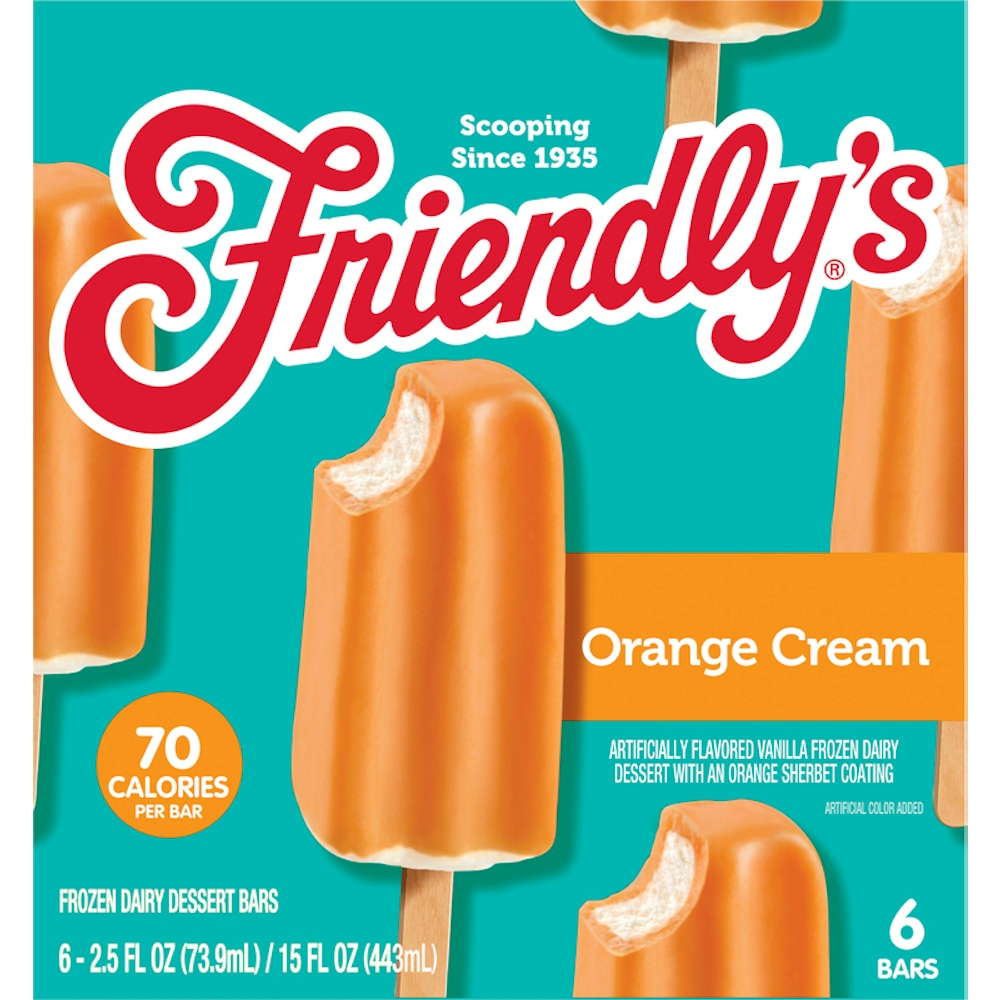
Friendly's
Friendly's Ice Cream Bars, Orange Creme
Sugar · Corn Syrup · Cream
Standout ingredient: Sweetcream Buttermilk
Analysis by Aurascan. The app shows the full breakdown and its sources.
Preservatives and Sweeteners: Sodium Benzoate vs Multi-Sugar Blends
The two listings also differ on preservatives and sweeteners.
Fanta lists sodium benzoate, a chemical preservative. Under 21 CFR 101.22(j), food labels declaring a chemical preservative are required to include a separate description of its function, such as "preservative" or "to retard spoilage." In the Open Food Facts listing for Fanta, no separate functional descriptor appears. However, transcription entries in crowd-sourced databases can be incomplete, so this absence in the database entry does not mean the physical can omits it or violates regulatory standards. Friendly's Open Food Facts listing shows no preservative.
Sweetener selection also differs:
- Fanta Orange: Relies on high fructose corn syrup as its sole caloric sweetener.
- Friendly's Orange Cream Bars: Lists sugar, corn syrup and high fructose corn syrup.
Specific sugar gram counts and calorie totals depend on portion sizes and should be verified on the Nutrition Facts panel of each package.
Texture and Stability: Wood Rosin Ester vs Traditional Plant Gums
Each product lists a different set of starches, gums and other stabilizers.
Fanta uses modified food starch and glycerol ester of rosin. Under 21 CFR 172.735, glycerol ester of rosin is permitted up to 100 parts per million in finished beverages to adjust the density of citrus oils. The US regulation permits rosin derived from wood, gum, or tall oil; the Open Food Facts listing does not disclose which variety is used in Fanta.
In the European Union, Regulation (EU) No 1129/2011 authorizes glycerol esters of wood rosins (E 445) at up to 100 mg/l in cloudy flavored drinks. In a 2023 follow-up opinion, EFSA's food additives panel set an Acceptable Daily Intake (ADI) of 10 mg/kg body weight per day for E 445 and found no safety concern at the maximum permitted levels or at reported use levels.
Friendly's relies on a traditional ice cream stabilizer blend consisting of guar gum, mono and diglycerides, carob bean gum, cellulose gum, carrageenan, and pectin. The Open Food Facts listing does not say which ingredient does which job in the bar.
US vs EU Regulatory Rules for Synthetic Food Dyes
The US and the EU handle these two dyes differently.
In the United States, the FDA's consumer Q&A on color additives says certified color additives are synthetic dyes used widely for intense, uniform color. It also notes that the totality of scientific evidence indicates most children experience no adverse effects from color additives, though some evidence suggests certain children may be sensitive. On April 22, 2025, the US Department of Health and Human Services and the FDA announced an initiative working with the food industry to phase out six petroleum-based synthetic dyes, including Yellow 6 and Red 40, by the end of 2026. This initiative is framed as an industry phase-out target rather than an immediate ban, and both dyes remain listed in 21 CFR Part 74.
In the European Union, the regulatory framework is stricter. Under Regulation (EC) No 1333/2008 (Article 24 and Annex V), foods containing Sunset Yellow (E 110 / Yellow 6) or Allura Red (E 129 / Red 40) must carry a mandatory warning statement: "may have an adverse effect on activity and attention in children." For an overview of how other additives are handled abroad, explore our guide on EU Warning-Label Additives Still Allowed in the US.
The EU warning followed a 2007 randomized, double-blinded, placebo-controlled trial conducted by McCann and colleagues, published in The Lancet. The researchers tested challenge drinks containing sodium benzoate combined with artificial food color mixes on 153 3-year-old children and 144 8- to 9-year-old children, concluding that artificial colors or a sodium benzoate preservative (or both) in the diet resulted in increased hyperactivity in the general population. Commission Regulation (EU) No 232/2012 later recited a 2009 EFSA opinion that recommended lowering Sunset Yellow's temporary ADI from 2.5 to 1 mg/kg body weight per day, and it set a limit of 20 mg/l for Sunset Yellow in flavored drinks (excluding chocolate milk and malt products). It cannot be established from this scientific literature whether consuming normal dietary amounts of Fanta or Friendly's bars poses an individual health risk.
Which Should You Pick: Fanta Orange or Friendly's Orange Cream?
Which label fits depends on what you are trying to avoid:
- Avoiding Red 40 or sodium benzoate: only Fanta lists them. Friendly's lists Yellow 6 but neither of those two.
- Looking for real orange ingredients: only Friendly's lists orange pulp and concentrated orange juice.
- Avoiding milk or carrageenan: Friendly's is milk-based and lists carrageenan; Fanta's listing has neither, and it is shorter overall (9 ingredients vs 20).
- Avoiding certified dyes altogether: both list Yellow 6.
Try Aurascan
See what is really in the food you buy.
Common questions
- Do both Fanta Orange and Friendly's Orange Cream bars contain Yellow 6?
- Yes. The Open Food Facts listings for both products disclose Yellow 6 at the very end of their ingredient decks, indicating it is present in small amounts relative to other ingredients.
- Does Fanta Orange contain real orange juice?
- No. The Open Food Facts listing for US Fanta Orange soda lists 'natural flavors' without any orange juice or pulp. In contrast, Friendly's Orange Cream bars list both orange pulp and concentrated orange juice.
- Why does Fanta contain glycerol ester of rosin?
- Under 21 CFR 172.735, glycerol ester of rosin is used to adjust the density of citrus oils in beverages, at no more than 100 parts per million of the finished drink.
- What is the difference in dye labeling between the US and the EU?
- In the US, synthetic dyes like Yellow 6 and Red 40 require batch certification and are labeled simply as 'Yellow 6' or 'Red 40'. In the EU, products containing these dyes must carry a label warning stating that the colorant 'may have an adverse effect on activity and attention in children'.
- Does Friendly's Orange Cream bar contain preservatives?
- The Open Food Facts listing for Friendly's Orange Cream bars shows no chemical preservatives. Fanta Orange soda lists sodium benzoate, a chemical preservative.
Sources
- 21 CFR 172.735 - Glycerol ester of rosin (ecfr.gov)
- Color Additives Questions and Answers for Consumers (fda.gov)
- HHS and FDA Announce Steps to Phase Out Synthetic Dyes (fda.gov)
- Regulation (EC) No 1333/2008 on Food Additives (eur-lex.europa.eu)
- Summary of Color Additives for Use in the United States in Foods, Drugs, Cosmetics, and Medical Devices (fda.gov)
- Commission Regulation (EU) No 232/2012 (conditions of use for E 104, E 110, E 124) (eur-lex.europa.eu)
- Commission Regulation (EU) No 1129/2011 (Annex II to Regulation (EC) No 1333/2008) (eur-lex.europa.eu)
- Follow-up of the re-evaluation of glycerol esters of wood rosins (E 445) as a food additive (EFSA Journal 2023;21(7):8110) (pmc.ncbi.nlm.nih.gov)
In this series
Guide
Doritos Nacho Cheese vs Pringles Hot Honey: Label CheckGuide
Unlisted Dyes and Sulfites Trigger Three FDA RecallsGuide
Digested Titanium Dioxide Damaged Gut Cells in a Lab StudyGuide
FDA Weighs Calcium Sulfate as a New Food ColorGuide
Annatto: The Seed Color in Cheese and SnacksGuide
Is Caramel Color (E150) Safe? 4-MEI, Classes, and Labels
Related guides
Guides
Color Added vs Named Colors: 6 Scanned Labels Without FD&C DyesAnnatto, paprika extract, fruit juice, or just color added: how 6 scanned products name colors that skip FDA batch certification, and what 21 CFR 101.22 allows.
Latest News
Sunset Yellow in Pregnancy: New Rat Study Finds Few EffectsA new rat study of the dye Sunset Yellow (Yellow 6) during pregnancy found no harm to mothers or fetal growth, with one preliminary finding at the highest dose.
Comparisons
Gatorade vs Powerade: Sugar, Sodium and ElectrolytesPer 12 fl oz Powerade lists 240mg sodium and 80mg potassium; Gatorade 160mg and 50mg. Compare sugars, HFCS vs sugar and dextrose, dyes and additives.
Try it on your own groceries
Scan your next label with Aurascan
Point the camera at any ingredient list and get the same evidence-graded read you see here.
Open the scannerGet food recall alerts + a weekly digest
An email when a food recall is announced, plus one weekly roundup of label news and new guides.
We email a confirmation link first - nothing is sent until you click it. Unsubscribe anytime. Privacy