
Latest News · September 29, 2026 · 6 min read
EFSA Can't Confirm Safety of a New Cricket Protein Powder
EU food-safety scientists said a spray-dried cricket powder's safety cannot be established, citing mineral-oil residues, phthalates, bacteria and allergy risk.
By Chris Carrillo · Reviewed by Armin Rad, Co-Founder & CTO, Aurascan · September 29, 2026
Every article is checked against primary sources before publication. How we review
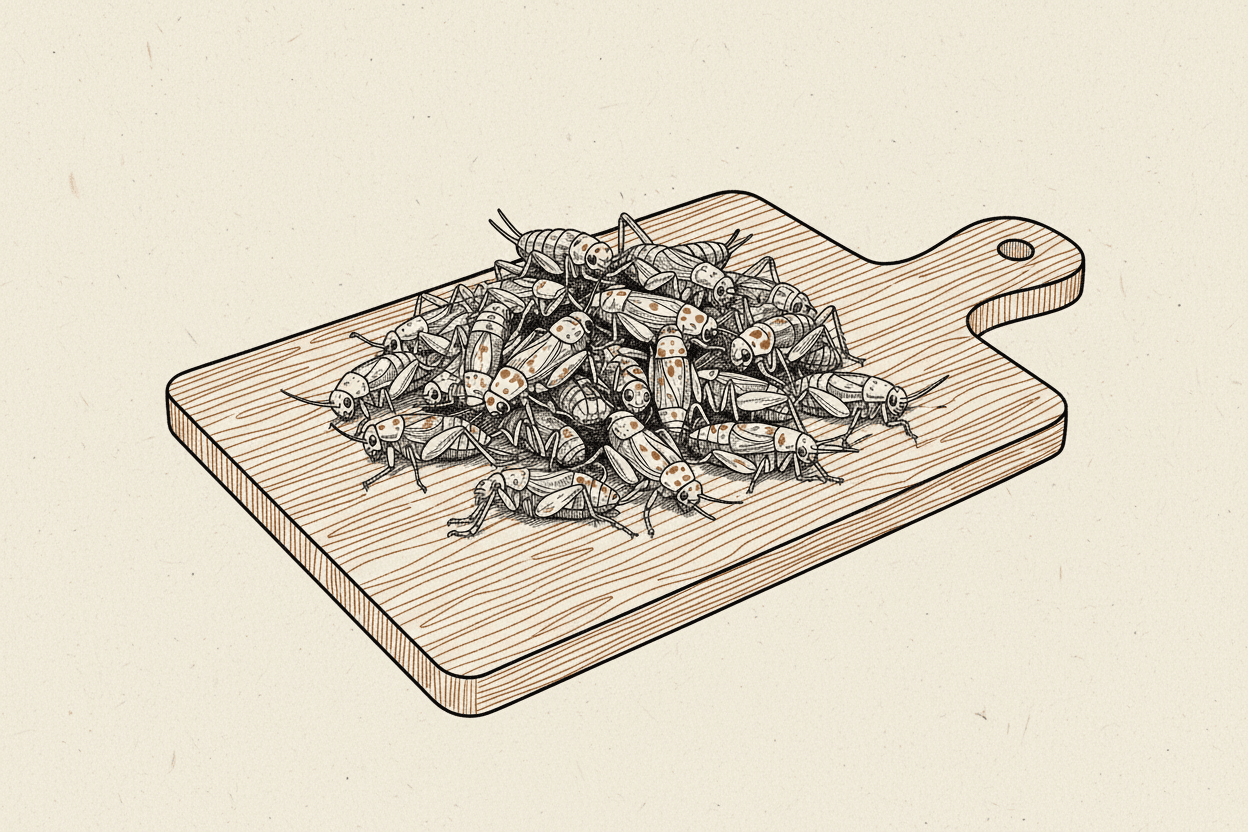
On September 25, 2026, the European Food Safety Authority (EFSA) published an opinion concluding that the safety of a house cricket (Acheta domesticus) spray-dried powder cannot be established under its proposed uses. In the dossier submitted by Alia Insect Farm, EFSA's panel found mineral oil aromatic hydrocarbon (MOAH) levels above a proposed EU limit, phthalates of undetermined origin, and wide swings in microbial counts.
Key takeaways
- EFSA's NDA Panel concluded that the safety of Alia Insect Farm's spray-dried Acheta domesticus powder cannot be established under proposed conditions.
- Safety concerns centered on MOAH levels above a proposed 1 mg/kg limit, phthalates of undetermined origin, and wide swings in Bacillus cereus counts.
- This assessment applies specifically to this applicant's pilot-scale production process, not to cricket-derived ingredients already authorized in the EU under prior regulations.
- The European Commission and member states will determine the formal authorization outcome, with no final decision date currently specified.
What happened
On September 25, 2026, EFSA published a scientific opinion regarding an application submitted by Alia Insect Farm società agricola S.R.L. under Regulation (EU) 2015/2283. The application, originally submitted to the European Commission on April 5, 2023, sought authorization to place spray-dried powder made from the house cricket (Acheta domesticus) on the market as a novel food. The opinion, EFSA Journal 24(9):e9946 (doi: 10.2903/j.efsa.2026.9946, full text on PubMed Central), was adopted by EFSA's Panel on Nutrition, Novel Foods and Food Allergens (NDA) on January 28, 2026. The published document does not explain the gap between adoption in January and publication in September.
The applicant sought clearance to market the insect powder as a food ingredient across multiple packaged food categories. These proposed uses covered bakery products, snacks, pasta, confectionery, desserts, and sauces, with proposed maximum use levels ranging between 1 and 40 grams per 100 grams of finished food. The applicant proposed the general population, excluding children under three years of age, as the target group, but EFSA's panel noted that other population groups could not be excluded.
The panel's conclusion was that "the safety of the NF under the proposed uses and use levels cannot be established." The opinion is scientific advice, not an authorization decision; that decision rests with the European Commission and EU member states.
What changed and why did the cricket powder fail safety tests?
The powder is mainly protein and fat, containing crude protein measured at 57.00 to 60.90 grams per 100 grams, true protein between 45.15 and 49.79 grams per 100 grams, and fat content ranging from 26.20 to 29.50 grams per 100 grams. The chemical and microbiological analyses of the applicant's batches are set out in the full opinion.
First, testing detected mineral oil aromatic hydrocarbons (MOAH, up to C50) at concentrations of 4.8 to 6.6 mg/kg across five tested batches. The NDA Panel noted that these levels exceed the proposed limit of 1 mg/kg set by the European Commission's Health and Food Safety Directorate-General in 2022 and "thus raises safety concerns."
Second, the analysis revealed the presence of multiple plasticizers known as phthalates. Across tested batches, laboratory results detected:
- Diisobutyl phthalate (DIBP): 0.04 to 0.14 mg/kg
- Dibutyl phthalate (DBP): <0.02 to 0.12 mg/kg
- Bis(2-ethylhexyl) phthalate (DEHP): 0.15 to 0.30 mg/kg
- Diisononyl phthalate (DINP): 0.14 to 1.80 mg/kg
- Diisodecyl phthalate (DIDP): <0.01 to 0.70 mg/kg
The panel said the source of these phthalates could not be determined from the evidence provided, and it noted a lack of documentation on the food-contact materials used.
Third, microbiological quality varied widely. While standard pathogens like Salmonella, Listeria monocytogenes, Campylobacter, Staphylococcus aureus, and Escherichia coli were not detected across 10 tested batches, other counts varied. Total microbial counts swung from 530 to 48,000 CFU/g, and presumptive Bacillus cereus counts ranged from 160 to 13,000 CFU/g. The applicant attributed this variability to a pilot-scale process characterized by multiple manual handling steps and an external spray-drying facility that also processes other products. The applicant stated that no further corrective actions could be implemented at that stage, and the NDA Panel concluded that the proposed specifications do not capture this variability and are insufficient to ensure product safety.
Who is affected by this novel food ruling?
This decision directly affects Alia Insect Farm società agricola S.R.L. and its planned commercial distribution of spray-dried cricket powder within the European Union. Food makers cannot use this specific powder in the EU unless it is authorized, and this opinion does not support authorization under the uses as submitted.
People with food allergies are the other group the opinion addresses. The panel said eating the powder may trigger primary sensitization to cricket proteins. Furthermore, people allergic to crustaceans, mites or molluscs may react to cricket proteins through cross-reactivity. The panel added that allergens from the crickets' feed may also be present in the powder.
Crustacean shellfish is one of the major US allergens; our guide to food allergen labels covers how allergens are named on packaging.
What it means for shoppers
For grocery shoppers, this opinion is not a recall. The opinion also does not say whether this applicant's powder is sold anywhere now. According to the opinion, Acheta domesticus is considered non-novel in Canada, and it is marketed in the EU, Australia and the United States as a whole insect or in products such as nutritional bars, lollipops, flour and chocolate.
EFSA's opinion does not apply to all cricket-derived ingredients on store shelves. The concerns are specific to Alia Insect Farm's pilot-scale batches; the opinion makes no new finding about cricket powders already authorized in the EU or sold in the US. Shoppers who want to avoid insect ingredients can check ingredient lists for names such as Acheta domesticus or house cricket powder.
Phthalates from plastics turn up in other foods too; see our report on baby food tests finding microplastics and phthalates.
The background on house cricket authorization in the EU
House cricket ingredients have been assessed by EFSA several times. Under Regulation (EU) 2015/2283, a novel food needs a pre-market safety assessment and EU authorization before it can be sold.
Several house cricket products are already authorized. After a positive vote of the Standing Committee on Plants, Animals, Food and Feed, the European Commission authorized frozen, dried, and powder formulations of Acheta domesticus under Commission Implementing Regulation (EU) 2022/188. In addition, partially defatted Acheta domesticus powder achieved formal authorization under Commission Implementing Regulation (EU) 2023/5. In an opinion adopted on June 26, 2024, EFSA found another Acheta domesticus powder safe under its proposed conditions of use.
Against that background, the new opinion turns on this applicant's data, not on a finding that house crickets are unsafe to eat. For Alia Insect Farm's powder, the MOAH levels, phthalates of undetermined source, and variable microbial counts from a pilot-scale process with manual handling steps meant the panel could not establish safety.
What to watch next and how will regulators decide?
An EFSA opinion is a scientific assessment, not an EU ban. The decision to grant or refuse authorization rests with the European Commission and EU member states, and the opinion gives no decision date.
The opinion does not say whether the applicant will change its process, move to large-scale production, or resubmit with new batch data.
One limitation: there are no human feeding or allergy-challenge data for this specific powder, so the allergy conclusion rests on known cross-reactivity. Whether a different production process would bring MOAH and Bacillus cereus counts within acceptable limits is not something the opinion addresses.
Try Aurascan
See what is really in the food you buy.
Common questions
- Did EFSA ban house cricket powder in the European Union?
- No. EFSA issued a scientific opinion stating that safety could not be established for one specific spray-dried powder produced by Alia Insect Farm. Formal authorization decisions are made by the European Commission, and other cricket powders remain authorized.
- Why did EFSA raise safety concerns about this specific cricket powder?
- Testing showed mineral oil aromatic hydrocarbons (MOAH) measuring 4.8 to 6.6 mg/kg, above a proposed limit of 1 mg/kg set by the European Commission's health directorate. The panel also found phthalates of undetermined source and high variability in Bacillus cereus counts (up to 13,000 CFU/g).
- Are other cricket powders still legal in the EU?
- Yes. Acheta domesticus is authorized in frozen, dried, and powder forms under Regulation (EU) 2022/188, and as partially defatted powder under Regulation (EU) 2023/5. EFSA also adopted a safe opinion on another cricket powder in June 2024.
- Can people with shellfish allergies eat foods containing house cricket powder?
- EFSA says people allergic to crustaceans, molluscs or mites may react to cricket proteins through cross-reactivity, and eating cricket protein may also cause new sensitization. Anyone with these allergies should check labels for cricket or insect ingredients.
- Where did the contamination in this cricket powder come from?
- The applicant attributed microbial swings to pilot-scale manual handling and an external spray-drying facility. EFSA said the source of the phthalates could not be determined from the evidence provided.
Sources
In this series
Guide
Ultra-Processed Food and Kidney Disease: What a New Study FoundGuide
So Delicious Salted Caramel Cluster Recalled Again for StonesGuide
FDA Adds Tejocote Weight-Loss Products to Yellow Oleander WarningGuide
Cutting Ultra-Processed Food Eased Depression in a Pilot TrialGuide
Graziers Raw Milk Cheese Recall: E. coli Outbreak Sickens 13Guide
Walmart bettergoods Lemon Alfredo Fettuccine Listeria Recall
Related guides
Latest News
Todd's Seeds Alfalfa Sprouting Seeds Recalled: E. coli, SalmonellaTodd's Seeds alfalfa sprouting seeds (lot SAL2-24JB) and 5 seed mixes sold on Amazon, use by 12/31/2029, are recalled for E. coli and Salmonella. Lots inside.
Latest News
7UP Tropical Zero Sugar Cans Recalled: Full-Sugar Soda InsideCans labeled 7UP Tropical Zero Sugar (lot UT06176, best by Mar 17, 2027) in Utah 7UP Tropical 12-packs held full-sugar soda. How to check yours.
Latest News
Gardeners Basics Broccoli Sprouting Seeds Recalled: SalmonellaGardeners Basics broccoli sprouting seeds sold on Amazon, Walmart, TikTok Shop, eBay and Etsy are recalled, linked to a 32-case Salmonella outbreak.
Try it on your own groceries
Scan your next label with Aurascan
Point the camera at any ingredient list and get the same evidence-graded read you see here.
Open the scannerGet food recall alerts + a weekly digest
An email when a food recall is announced, plus one weekly roundup of label news and new guides.
We email a confirmation link first - nothing is sent until you click it. Unsubscribe anytime. Privacy