
Latest News · October 2, 2026 · 7 min read
Ultra-Processed Food Trials: Weight Gain Clear, Cause Less So
A review of 10 randomized trials found ultra-processed diets led to more weight gain, but higher energy density may explain it and certainty is rated low.
By Chris Carrillo · Reviewed by Armin Rad, Co-Founder & CTO, Aurascan · October 2, 2026
Every article is checked against primary sources before publication. How we review
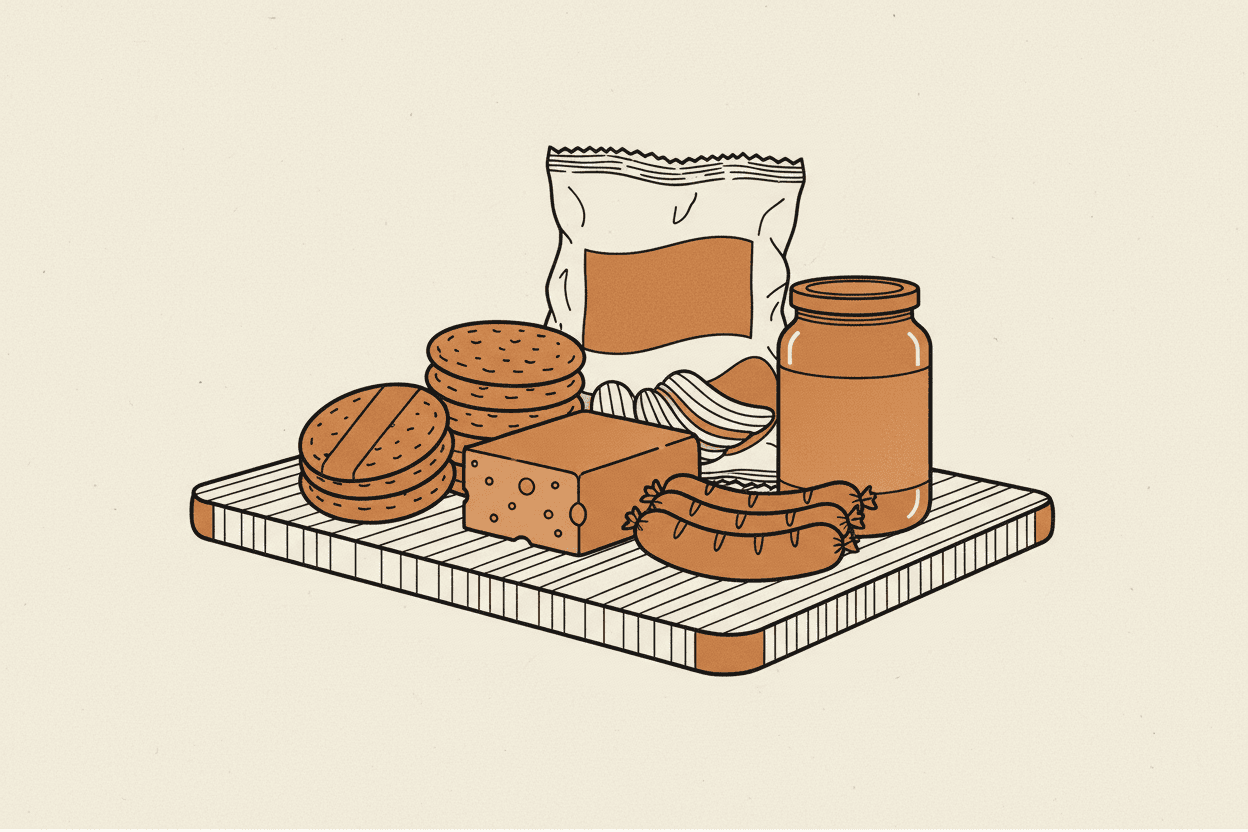
On September 16, 2026, researchers published a systematic review and meta-analysis of randomized controlled trials comparing ultra-processed diets with less processed diets for energy intake and weight gain. Analyzing 10 trials, the study revealed that while ultra-processed food regimens led to an average weight gain of 1.37 kg, the overall effect on daily calorie intake was not statistically significant across all studies. In a subgroup analysis, higher calorie intake appeared only in comparisons where the ultra-processed diet was more energy-dense, which the authors say potentially challenges common assumptions that ultra-processed food increases energy intake.
Key takeaways:
- A systematic review of 10 randomized trials published on September 16, 2026, found ultra-processed diets drove a statistically significant average weight increase of 1.37 kg, but evidence certainty remains low.
- The overall effect of ultra-processed food on daily calorie intake was not statistically significant (p = 0.068) across all trials, which the authors say potentially challenges common assumptions that ultra-processed food increases energy intake.
- In a subgroup analysis, calorie intake was higher when ultra-processed diets were more energy-dense (SMD 0.71), but not when energy density was similar or lower (SMD 0.02).
- People ate faster on ultra-processed diets, and bigger eating-rate differences predicted bigger energy-intake differences, whereas ratings for hunger, fullness, and palatability showed no significant differences.
- The authors found no convincing evidence from the reviewed trials that ultra-processing affects energy intake independent of nutrient profile.
What happened
On September 16, 2026, a team of researchers led by Eric Robinson published a systematic review and meta-analysis in Critical Reviews in Food Science and Nutrition examining the effect of ultra-processed food (UPF) on energy intake and weight gain. The open-access paper evaluated data across 10 randomized controlled trials (RCTs) that directly compared diets rich in ultra-processed foods against diets consisting of less processed foods (LPF).
The search spanned PubMed, Scopus, and Cochrane databases through November 2025, alongside medRxiv, OSF, and Google Scholar. The final dataset included trials published from 2019 through 2026: Hall 2019, Teo 2022, Lasschuijt 2023, Hamano 2024, de Oliveira 2025, Dicken 2025, Preston 2025, Discepoli 2026, Larcom 2026, and Rego 2026. The trials were conducted across the United States (3 trials), Europe (4 trials), Brazil (1 trial), Singapore (1 trial), and Japan (1 trial).
The authors reported mixed findings: while participants on ultra-processed regimens experienced a statistically significant increase in body weight across 5 trials measuring that outcome, the overall effect on daily calorie intake across 7 trials was not statistically significant. The authors described mixed evidence on energy intake, potentially challenging common assumptions that UPF increases energy intake, and more consistent evidence for weight gain from a smaller subset of trials.
What changed
The review pooled the trial results and graded the certainty of the evidence.
Across 7 studies providing 10 effect sizes, the standardized mean difference (SMD) for energy intake between UPF and LPF diets was 0.34 (95% CI -0.03 to 0.70, p = 0.068), with substantial heterogeneity (I2 = 88%). Because the confidence interval crossed zero, the pooled effect on daily calorie intake was not statistically significant across all trials. When researchers removed one outlying effect, the difference became significant (SMD 0.47, 95% CI 0.14 to 0.80). However, applying a Trim and Fill adjustment to account for potential publication bias yielded an SMD of 0.18 (95% CI -0.19 to 0.56). In descriptive terms, across the 5 studies measuring daily energy intake in calories, the raw difference was +307.19 kcal per day (95% CI 3.29 to 611.10).
For body weight, evaluated across 5 studies reporting 6 effect sizes with interventions ranging from 1 week to 6 months, ultra-processed diets produced a statistically significant increase (SMD 0.65, 95% CI 0.38 to 0.94, p < 0.001, I2 = 40.9%). The raw pooled weight change was +1.37 kg (95% CI 1.00 to 1.74 kg).
Crucially, the meta-analysis investigated whether food processing itself caused this effect or whether standard nutritional properties were responsible. The trials did not match UPF and LPF diets for underlying nutrient profiles; UPF arms typically contained more saturated fat, salt, and sugar, and less dietary fiber. When ultra-processed diets were more energy-dense than less processed diets, calorie intake was significantly higher (SMD 0.71, 95% CI 0.45 to 0.98). However, when UPF diets had similar or lower energy density than LPF diets, no effect was seen (SMD 0.02, 95% CI -0.51 to 0.55).
Under the GRADE system, the certainty of evidence was rated as low for both energy intake and body weight. For the specific hypothesis that food processing affects weight independently of calorie density and nutrient profile, certainty was rated as very low.
Who is affected
The populations studied in these 10 trials represent a mix of controlled laboratory volunteers and free-living participants. Seven trials used cross-over designs, two used parallel groups, and one used a mixed design. Five took place in tightly controlled inpatient or laboratory settings, while five were conducted under real-world conditions. Eight trials directly provided all food to participants, while two provided dietary advice to reduce ultra-processed food intake. Three of the trials specifically enrolled participants living with overweight or obesity.
Because the meta-analysis examined human clinical trials rather than retail shelves, it did not assess specific packaged product formulations or commercial brands. The individual trials evaluated dietary patterns rather than isolated food additives. The review does not identify any specific additive, emulsifier, artificial sweetener, or chemical processing agent as the causal agent of weight gain.
Furthermore, long-term health outcomes remain unestablished. The duration of weight tracking in these trials ranged from just 1 week to 6 months. Observational studies have linked ultra-processed food to long-term outcomes, such as in this review of 8.8 million adults, but those designs cannot show cause the way trials can. For how the US is approaching a definition, see US to Define 'Ultra-Processed Food': What the Proposal Means.
What it means for shoppers
For consumers navigating supermarket aisles, the review suggests processing labels alone do not tell the whole story. In comparisons where the ultra-processed diet was not more energy-dense, it did not lead to greater calorie intake than the less processed diet. The paper does not name any brand or product.
The review also found that eating rate was significantly faster on ultra-processed diets (SMD 0.96, 95% CI 0.12 to 1.80). Trials with larger differences in eating speed also showed larger differences in excess calorie consumption. In contrast, subjective ratings of palatability showed no significant difference between diets (SMD 0.38, 95% CI -0.06 to 0.81), nor did ratings of hunger (SMD 0.07) or fullness (SMD 0.13). Calorie intake later in the day, evaluated in 3 trials, was likewise unaffected.
The background
The trials used the Nova classification, which groups foods into four categories based on the extent and purpose of industrial processing. The landmark 2019 inpatient trial by Kevin Hall and colleagues at the National Institutes of Health (NIH) provided early controlled evidence. In that study, 20 adults consuming an ultra-processed diet consumed an extra 508 +/- 106 kcal per day compared to an unprocessed diet.
Although the abstract of the Hall 2019 study noted that meals were designed to be matched for presented calories, energy density, macronutrients, sugar, sodium, and fiber, the Robinson 2026 meta-analysis classed Hall 2019 among the comparisons where the ultra-processed diet was more energy-dense.
In the United States, the Food and Drug Administration's ultra-processed foods page (current as of September 2025) said there was no uniform federal definition and that FDA was working with the U.S. Department of Agriculture (USDA) to develop one, after a request for information issued on July 24, 2025.
Methodological quality across the 10 included trials was generally solid. The authors rated 8 of the 10 trials as having 'Good' risk-of-bias scores, while Dicken 2025 was rated 'Neutral' and Discepoli 2026 was rated 'Poor'. Funding for the meta-analysis project was provided by the NIHR Oxford Health Biomedical Research Centre (NIHR203316), which supports the salaries of Eric Robinson and V. Norton, with additional co-author support from the Economic and Social Research Council and the Medical Research Council. The authors declared that no external body or organization was involved in developing the manuscript. Robinson disclosed past investigator roles between 2014 and 2016 on projects funded by Unilever and the American Beverage Association, noting he does not receive financial awards or fees from the food industry. Data from the review is designated to be posted on the Open Science Framework repository.
What to watch next
The central open question is whether processing matters once energy density and nutrient profile are matched. The Robinson 2026 review concluded that, at present, there is no convincing randomized evidence that ultra-processing per se alters calorie intake independently of nutrient profile.
The authors list few RCTs, mixed designs and populations, high heterogeneity, short follow-up for weight and limited databases among the review's limitations; weight results come from 5 trials lasting 1 week to 6 months, so long-term effects are not established. For consumers evaluating everyday packaged grocery items, Aurascan is a free scanner app in beta that provides ingredient-by-ingredient evidence checks with Clean, Mixed, or Flagged verdicts rather than a black-box score.
Try Aurascan
See what is really in the food you buy.
Common questions
- What did the 2026 meta-analysis discover about ultra-processed food and weight gain?
- The meta-analysis of 10 randomized controlled trials found that participants on ultra-processed diets experienced a statistically significant average weight increase of 1.37 kg compared to minimally processed diets, based on 5 trials measuring weight over 1 week to 6 months. However, the evidence certainty was rated as low.
- Do ultra-processed foods make you consume more calories?
- Across all 7 trials evaluating energy intake, the overall difference in daily calorie consumption was not statistically significant (SMD 0.34, p = 0.068). Calorie intake only increased significantly in trials where the ultra-processed diet was more energy-dense than the comparison diet.
- Does food processing alone cause weight gain without extra calories or fat?
- No. The authors concluded there is at present no convincing evidence from the reviewed trials that ultra-processing affects energy intake independent of nutrient profile. Certainty for any effect of processing independent of nutrient profile was rated very low.
- Why did participants eat more on certain ultra-processed diets?
- The review points to two patterns: calorie intake was higher only when the ultra-processed diet was more energy-dense, and participants ate significantly faster on ultra-processed diets (SMD 0.96), and bigger eating-rate differences predicted bigger intake differences, while ratings for hunger, fullness, and palatability showed no significant differences.
- Does the U.S. government have an official definition for ultra-processed foods?
- The FDA states that there is no uniform federal definition for ultra-processed food. The FDA is actively collaborating with the USDA to develop a standardized definition and issued a formal request for information on July 24, 2025.
Sources
- A systematic review and meta-analysis of randomized controlled trials examining the effect of ultra-processed food on energy intake and weight gain (doi.org)
- A systematic review and meta-analysis of randomized controlled trials examining the effect of ultra-processed food on energy intake and weight gain (PubMed) (pubmed.ncbi.nlm.nih.gov)
- Ultra-Processed Diets Cause Excess Calorie Intake and Weight Gain: An Inpatient Randomized Controlled Trial of Ad Libitum Food Intake (pubmed.ncbi.nlm.nih.gov)
- Ultra-Processed Foods (fda.gov)
In this series
Guide
Vegan vs Meat-Rich Diet: Mold Toxins in Urine After 8 WeeksGuide
Probiotic Juice Maker Skipped the Pathogen Kill Step, FDA SaysGuide
Ultra-Processed Food, Crohn's Risk and Low DHA: New StudyGuide
Burritos, Cheese, Fish Tied to PFAS in Kids' Blood: StudyGuide
Celsius vs Monster: Which Energy Drink Label Is Cleaner?Guide
Locust Bean Gum: Is It Safe? What 4 Scanned Labels Show
Related guides
Latest News
Study: Most Critics of the Nova UPF System Had Industry TiesA review in AJPH found 68.5% of authors of 69 articles critiquing the Nova ultra-processed food system had food-industry ties. What it does and does not show.
Latest News
Two Weeks of Ultra-Processed Food Didn't Dull Satiety HormonesA small Dutch trial fed young adults diets of about 95% ultra-processed food for two weeks. Gut fullness hormones did not change, though hunger ratings shifted slightly.
Comparisons
Coffee mate vs International Delight: Ingredients and SugarCoffee mate vs International Delight French Vanilla creamer: soybean/canola oil vs palm oil, sugar per tablespoon, carrageenan and the other additives on each label.
Try it on your own groceries
Scan your next label with Aurascan
Point the camera at any ingredient list and get the same evidence-graded read you see here.
Open the scannerGet food recall alerts + a weekly digest
An email when a food recall is announced, plus one weekly roundup of label news and new guides.
We email a confirmation link first - nothing is sent until you click it. Unsubscribe anytime. Privacy