
Comparisons · October 27, 2026 · 10 min read
Is Frigo Healthier Than Sargento? 80 vs 90 Cal per Stick
Frigo vs Sargento string cheese, label to label: same four basic ingredients, 80 vs 90 calories, 6 g vs 7 g protein and about 200 vs 190 mg sodium per stick.
By Chris Carrillo · Reviewed by Armin Rad, Co-Founder & CTO, Aurascan · October 27, 2026
Every article is checked against primary sources before publication. How we review

Frigo Cheese Heads Original and Sargento Mozzarella String Cheese are close on the label. Per 28 g stick, Frigo lists 80 calories, 6 g protein and 200 mg sodium, while Sargento lists 90 calories, 7 g protein and 190 mg sodium. Both ingredient lists name the same four components, so this comparison sets the label facts side by side for you to weigh for your lunchbox.
Key takeaways
- Per 28 g stick, Frigo Original lists 80 kcal, 6 g protein and 200 mg sodium. Sargento lists 90 kcal, 7 g protein and 190 mg sodium.
- The two ingredient lists are nearly identical: milk, culture, salt and enzymes. Frigo names its product low-moisture part-skim mozzarella cheese.
- Under federal standards (21 CFR 133.158), low-moisture part-skim mozzarella has milkfat of less than 45% but at least 30% on a solids basis.
- FDA considers sodium at 5% DV or less low and 20% DV or more high. Both sticks fall between those cutoffs. Frigo's 9% DV is a calculation, not a value printed on the label.
- Several details, including Frigo's calcium, sugar and enzyme source, are not disclosed, and this article does not guess at them.
Frigo vs Sargento String Cheese: Which Label Fits Your Lunchbox?
Frigo and Sargento differ by 10 calories, 1 g of protein and 10 mg of sodium per 28 g stick: Frigo is lower on calories and protein and higher on sodium. The table uses one 28 g stick as the common serving, which matches the Sargento label and the Open Food Facts entry for Frigo.
| Label item (per 1 stick, 28 g) | Frigo Cheese Heads Original | Sargento Mozzarella String Cheese |
|---|---|---|
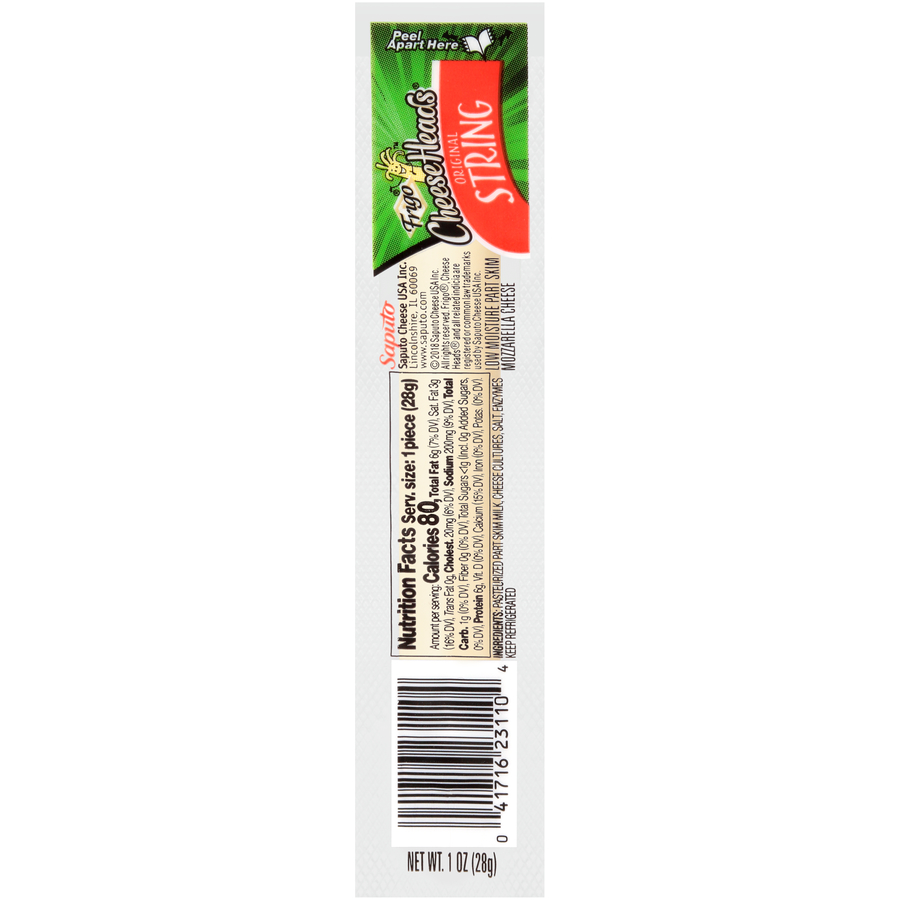
| Calories | 80 kcal | 90 kcal |
| Total fat | 6 g | 6 g |
| Saturated fat | 3 g | 3 g (15% DV) |
| Trans fat | Not disclosed | 0 g |
| Cholesterol | Not disclosed | 15 mg (5% DV) |
| Sodium | 200 mg (about 9% DV, calculated) | 190 mg (8% DV) |
| Total carbohydrate | 1 g | 1 g |
| Fiber | Not disclosed | 0 g |
| Total sugars | Not disclosed | 0 g |
| Protein | 6 g | 7 g |
| Calcium | Not disclosed | 15% DV |
| Potassium | Not disclosed | 55 mg |
| Ingredients | Low moisture part skim mozzarella cheese (pasteurized part skim milk, cheese cultures, salt, enzymes) | Pasteurized Part-Skim Milk, Cheese Culture, Salt, Enzymes |
Note: Frigo's fat, saturated fat, carbohydrate and sodium values come from an Open Food Facts entry, not from the brand page. Frigo's sodium %DV is calculated against the 2,300 mg Daily Value.
If you pack two sticks, double each per-stick figure. Two Frigo sticks total 160 calories and 12 g protein, and two Sargento sticks total 180 calories and 14 g protein, based on the per-stick values above.
When you compare these labels for a lunchbox, check these items first:
- Serving size, and how many sticks are in one package
- Calories and protein per stick
- Sodium in milligrams and as a percent of Daily Value
- The ingredient list, including the dairy and enzyme terms
- Pack count, since Frigo sells packs of 3, 12, 16, 24, 36, 48 and 60, and Sargento's 12-count container lists 12 servings
Frigo vs Sargento String Cheese: How Do the Ingredient Lists Compare?
The two labels list the same four components: milk, cheese culture, salt and enzymes. The main wording difference is that Frigo's ingredient text names the product as low-moisture part-skim mozzarella cheese, while Sargento's list begins with pasteurized part-skim milk.
Frigo's listing reads: low moisture part skim mozzarella cheese (pasteurized part skim milk, cheese cultures, salt, enzymes). Sargento's reads: Pasteurized Part-Skim Milk, Cheese Culture, Salt, Enzymes. Frigo uses the plural 'cheese cultures' and Sargento uses the singular 'Cheese Culture.' These are wording differences in the lists as printed, not additional ingredients.
Neither label states the enzyme source, so whether the enzymes are animal or microbial in origin is not disclosed for either brand. Neither label lists an anti-mold agent such as natamycin, so this article cannot confirm whether one is used. Cellulose, an anti-caking agent sometimes found in shredded cheese, does not appear on the Frigo or Sargento string cheese ingredient lists as printed on their labels.
Is Frigo String Cheese Healthy? What the 28 g Label Shows
Frigo Original lists 80 calories, 6 g of protein and 200 mg of sodium per 28 g stick, but the brand page does not display a full Nutrition Facts panel. The brand page describes the stick as having 'only 80 calories with 6 grams of protein.'
The fat and carbohydrate figures come from an Open Food Facts entry for a 24 oz pack, which lists 6 g fat, 3 g saturated fat and 1 g carbohydrate per 28 g stick. Open Food Facts is a community-maintained database, so its values are not the manufacturer's panel. Sugar per stick and calcium are not disclosed here, because entries in that database conflict on them.
Whether this snack fits a diet depends on the rest of what a person eats and on individual health needs. The 200 mg of sodium is about 9% of the 2,300 mg Daily Value, a percentage calculated here rather than printed on the label. People who track sodium or saturated fat for medical reasons are generally advised to set targets with a clinician.
Is Sargento String Cheese Healthy? What the 28 g Label Shows
Sargento lists 90 calories, 7 g protein and 190 mg sodium per 28 g stick on its product page. The same page lists 3 g of saturated fat (15% DV), 6 g total fat, 0 g trans fat, 15 mg cholesterol (5% DV), 1 g total carbohydrate, 0 g fiber, 0 g total sugars, 15% DV calcium, 0% DV vitamin D, 0% DV iron and 55 mg potassium.
The page includes the note '*See nutrition facts panel for saturated fat content,' which directs readers to the full panel for that figure. It also markets the product as '100% real, natural cheese.'
As with Frigo, people with medical reasons to limit sodium or saturated fat are generally advised to set targets with a clinician.
How Much Protein Does Frigo String Cheese Have per Stick?
Frigo Original has 6 g of protein per 28 g stick, according to both the brand page and the Open Food Facts entry. Sargento lists 7 g per 28 g stick on its product page, a difference of 1 g.
The Frigo brand page states '6 grams of protein' alongside its 80-calorie claim, and the Open Food Facts serving is 1 piece (28 g). Multiply the per-stick figure by the number of sticks you pack to estimate a lunchbox total. For a different example of reading grams of protein per serving, see Optimum Nutrition vs Premier Protein Powder: 24 g or 30 g?.
Protein needs vary from person to person, and a per-stick number alone does not show how much protein a full day contains.
Scan preview
Frigo
Frigo String Cheese, Original
Salt · Enzymes · Pasteurized Part Skim Milk
Standout ingredient: Cheese Cultures
Analysis by Aurascan. The app shows the full breakdown and its sources.
Is Frigo String Cheese Real Cheese? What the Standard of Identity Says
Yes, the Frigo ingredient listing names mozzarella cheese as its dairy base and describes the product as low-moisture part-skim mozzarella. Federal standards define that category.
Under 21 CFR 133.156, low-moisture mozzarella must contain at least 45% milkfat by weight of the solids, with moisture above 45% but not more than 52% by weight, and its dairy ingredients must be pasteurized. Under 21 CFR 133.158, low-moisture part-skim mozzarella follows the same framework except that milkfat on a solids basis is less than 45% but not less than 30%.
A standard of identity sets what a product must contain to be called by a given name. It is not a nutrition grade, and it does not confirm that a specific stick falls within the moisture or milkfat ranges. Neither the Frigo nor the Sargento label states moisture or milkfat percentages, so those figures cannot be checked from the packaging alone. Sargento's page describes its product as '100% real, natural cheese,' and its ingredient list has the same four components as Frigo's.
Is Frigo vs Sargento String Cheese Different on Sodium per Stick?
Yes, by 10 mg per 28 g stick: Frigo lists 200 mg and Sargento lists 190 mg. Both sticks fall between the FDA's low and high sodium cutoffs.
The FDA states that the Daily Value for sodium is less than 2,300 mg per day. It considers 5% DV or less per serving low and 20% DV or more high. Sargento's label shows 8% DV. Frigo's 200 mg is about 9% DV when calculated against 2,300 mg, and that figure comes from the Open Food Facts entry rather than the brand page.
Sodium levels differ widely across all kinds of packaged foods. For example, Pacific vs Swanson Chicken Broth: 530mg vs 860mg Sodium compares two broths on the same per-serving basis. People who need to limit sodium for medical reasons should confirm their own targets with a clinician.
How Do Frigo and Sargento Compare on Calories and Fat per Stick?
Frigo Original lists 80 calories per 28 g stick and Sargento lists 90, while both list 6 g of total fat and 3 g of saturated fat. The 10-calorie difference is the only calorie gap between the two labels.
The Frigo fat and saturated fat figures come from Open Food Facts, since the brand page does not show a panel. Sargento's 3 g of saturated fat is 15% DV, and its page points readers to the nutrition facts panel for that figure. Both products list 1 g of carbohydrate per stick. Sargento lists 15 mg of cholesterol per stick, while Frigo's cholesterol is not disclosed.
Per-pack calories equal the per-stick figure multiplied by the number of sticks you eat. A 12-count Sargento container lists 12 servings, and Frigo's packs range from 3 to 60 sticks.
Which Label Details Are Not Disclosed for These Two Sticks?
Several details are not disclosed for one or both products, and this article does not fill them in with guesses. These gaps matter if you are comparing the full label rather than the headline numbers.
- Frigo Nutrition Facts panel: not shown on the brand page, so Frigo's sodium, saturated fat and calcium %DV are not on that page.
- Frigo calcium amount and %DV: not disclosed, because Open Food Facts entries are inconsistent.
- Frigo sugar per stick: not disclosed, because Open Food Facts entries show either 0 g or 1 g.
- Enzyme source, animal or microbial, for either brand: not disclosed on either page.
- Anti-mold agents such as natamycin, for either brand: not listed on either page.
- Price per stick: not disclosed for either product.
Label values describe a standard serving. They cannot show how any one person's body responds to these sticks.
How to Read a String Cheese Label for Lunchbox Sodium and Protein
Start with the serving size, then compare calories, protein and sodium per stick, because many packages define one stick as one serving. Next, check the ingredient list for the dairy term, culture, salt and enzymes, and note any term you cannot identify.
- Confirm the serving size, such as 1 stick or 28 g.
- Multiply per-stick numbers by the number of sticks you pack.
- Compare sodium in mg and as %DV. The FDA reference is 2,300 mg per day, and 5% DV or less is considered low.
- Check protein per serving against the serving you actually pack.
- Read the ingredient list for dairy names, enzymes and any additive you want to research further.
- If a figure such as calcium or sugar is missing, record it as not listed rather than assuming zero.
A Daily Value is a reference point, not a personal target. A lunchbox usually combines several foods, so one snack's sodium is only part of the day's total.
Want to check a label yourself? Aurascan explains each ingredient on a scanned label with cited evidence. You can see a sample result and then scan your next label.
Try Aurascan
See what is really in the food you buy.
Common questions
- Is Frigo string cheese healthy?
- Frigo Original lists 80 calories, 6 g protein and 200 mg sodium per 28 g stick, but whether it fits a diet depends on the rest of the day's food and individual health needs. The brand page does not show a full Nutrition Facts panel, so fat and sodium figures come from Open Food Facts. People with sodium or saturated fat targets should confirm them with a clinician.
- Is Sargento string cheese healthy?
- Sargento's product page lists 90 calories, 7 g protein and 190 mg sodium (8% DV) per 28 g stick, with 3 g saturated fat (15% DV). Whether that fits a given diet depends on the rest of the day's food and individual needs.
- Is Frigo string cheese real cheese?
- Yes, the Frigo ingredient listing names mozzarella cheese and describes the product as low-moisture part-skim mozzarella, a category defined under 21 CFR 133.158. The label does not state the moisture or milkfat percentages, so those cannot be checked from the packaging alone.
- Does Frigo string cheese have rennet?
- Not disclosed. Neither the brand page nor the Open Food Facts ingredient text states whether the enzymes are animal or microbial in origin, so the label alone cannot answer that question.
- Is Sargento real cheese?
- Sargento's product page describes its string cheese as '100% real, natural cheese,' and its ingredient list names pasteurized part-skim milk, cheese culture, salt and enzymes. The label does not state moisture or milkfat percentages.
- How much protein does Frigo string cheese have?
- Frigo Original has 6 g of protein per 28 g stick (1 piece), according to both the brand page and the Open Food Facts entry. Sargento lists 7 g per 28 g stick on its product page.
Sources
- Frigo Cheese Heads String Cheese (Original) (frigocheeseheads.com)
- Frigo Original String Cheese (24 oz pack) product record (world.openfoodfacts.org)
- Sargento Natural String Cheese Snacks (sargento.com)
- 21 CFR 133.156 Mozzarella cheese (ecfr.gov)
- 21 CFR 133.158 Low-moisture part-skim mozzarella cheese (ecfr.gov)
- Sodium in Your Diet (fda.gov)
In this series
Guide
Pacific vs Swanson Chicken Broth: 530mg vs 860mg SodiumGuide
Optimum Nutrition vs Premier Protein Powder: 24 g or 30 g?Guide
Which Has More Sodium, French's or Grey Poupon? 55 vs 115 mgGuide
Does Daisy Cottage Cheese Have Gums? No, Nor Does Good CultureGuide
Does Shredded Cheese Have Cellulose? Sargento Yes, Tillamook NoGuide
Does Nutella Have Palm Oil? Nutella vs Nocciolata Ingredients
Related guides
Comparisons
Doctor's Best vs Nature Made Magnesium: Both 200 mgBoth list 200 mg magnesium (48% DV) per 2-unit serving. Doctor's Best uses a lysinate glycinate chelate; Nature Made lists bisglycinate. Labels compared.
Comparisons
Optimum Nutrition vs Premier Protein Powder: 24 g or 30 g?Premier Protein Chocolate Milkshake powder has 30 g protein per 41 g serving; ON Gold Standard Double Rich Chocolate has 24 g per 31 g scoop.
Comparisons
Which Has More Sodium, French's or Grey Poupon? 55 vs 115 mgPer 1 tsp (5 g), French's Classic Yellow Mustard lists 55 mg sodium and Grey Poupon Dijon lists 115 mg. Ingredients compared: turmeric and paprika vs white wine.
Try it on your own groceries
Scan your next label with Aurascan
Point the camera at any ingredient list and get the same evidence-graded read you see here.
Open the scannerGet food recall alerts + a weekly digest
An email when a food recall is announced, plus one weekly roundup of label news and new guides.
We email a confirmation link first - nothing is sent until you click it. Unsubscribe anytime. Privacy